Hostile
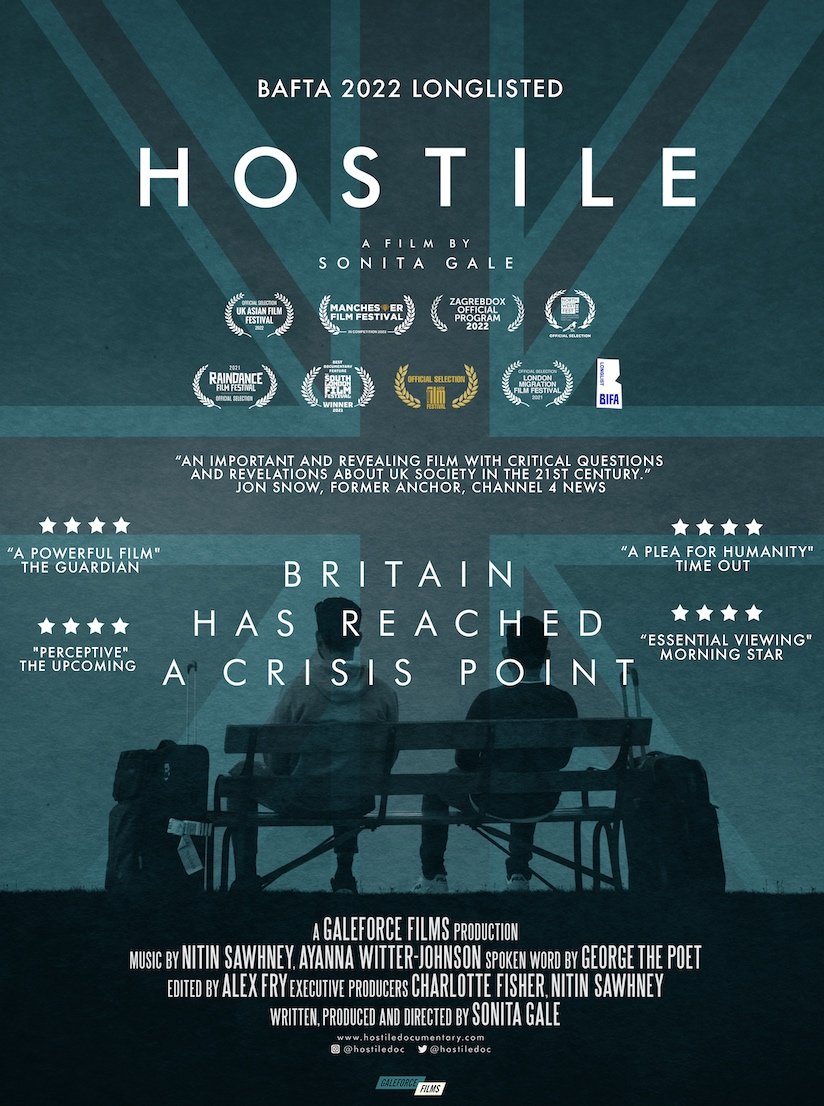
Hostile is a feature-length documentary focusing on the UK’s complicated relationship with its migrant communities. Told through the stories of four participants from Black and Asian backgrounds, the film reveals the impact of the evolving ‘hostile environment’ - a term used by the UK government in 2012 to illustrate the atmosphere they wanted to create for migrants, with the intention of provoking them to leave of their own accord.
Hostile explores how the lives of international students, members of the Windrush generation and ‘Highly-Skilled Migrants’ have been affected. After decades of hostile immigration policies, Britain has reached a crisis point. With Brexit, the Points Based Immigration System and the Nationality and Borders Bill taking effect, the film asks: once the ‘hostile environment’ has targeted all migrants, who will it extend to next?
Interview with Writer/Director/Producer Sonita Gale
Watch Hostile on BFI Player and NGTV
Congratulations! Why did you make your film?
My parents were the primary inspiration for the film. They migrated to the UK in the 1950s, almost a decade after their lives had changed dramatically due to the partition of India and Pakistan. Their story of migration, and of eventually making a home in England, became the seed of an idea to make a film about the experiences of migrant communities.
When lockdown began, I started to see the rising number of people who were unable to get their basic needs of food and shelter met.
This made me think of my childhood growing up in the Midlands with Sikh parents, and the support network we had amongst our mixed community in Wolverhampton. My father’s cornershop was the hub of this community.
When I began filming, my focus turned to the very communities I grew up with: Sikhs, Hindus, Muslims, Black and White working-class communities. The more I filmed, the more I learned about the Hostile Environment.
Meeting my participants and filming their unravelling narrative led me on a personal journey of discovery, one which linked my family’s history to the larger story of British identity, and the extent to which migrant communities, such as the one I grew up in, were essential to the fabric of this country.
As a filmmaker, the compelling personal nature of the story, combined with the fact that there were so many inconsistencies in our society and contradictions in our current political system, made me want to embark on my directing debut.
I wanted to make a film that highlights the inequalities of a system that affects migrant communities. In making and completing Hostile, I want to raise awareness of the issues migrants face in our country, and what it feels like to live day-by-day in such circumstances.
My goal is to start a dialogue between individuals who are unaware of these issues and to bring together grassroots organisations, law firms, policy-makers and politicians in order to enact positive change.
Hostile
Imagine I’m a member of the audience. Why should I watch this film?
Dear Audience Member,
I think you should watch Hostile because the issues we cover in it impact us all, whether we form part of the migrant population or not.
From watching the film you will have a greater understanding of the way migrants are treated by our government, the challenges they face, and the way they are discussed in the media.
We may think of immigration policies as something that impacts other people, but in this film we pose the question: “What happens when the hostile environment comes for us all?” In the UK, recent bills such as the Police, Crime, Sentencing and Courts Bill and the Nationality and Borders Bill recently passed through Parliament, and will impact UK citizens. This is not an abstract question.
The film allows you to understand our history by delving into the roots of immigration policies and the eras in which they came about.
And while we look at the UK’s immigration system, it shares many similarities with the one in Australia. Indeed, the Points Based Immigration System that was adopted after Brexit, was modelled after the one that has been in use in Australia for some time.
Audiences of all ages have come out to see the film. Those from the post war, post empire era are more familiar with some of the history the film covers. That said, younger people in particular have been coming out to see this film and support it, and universities, for example, have been in touch to express an interest in hosting screenings of the documentary. So it really is a film for all ages.
When considering the future that we want to achieve as a society, I hope the film will give you information about the hostile environment that you may not have known before. By doing so, we hope to inspire viewers to use their voice to influence the direction we are headed in, and consider practical solutions that will lead to real change.
Hostile
How do personal and universal themes work in your film?
The interweaving of the personal and the universal was something I had to think about a lot while making this film, in particular when considering my parent’s history. They have been interweaved in several ways:
i) With the personal narrative of the participants in the film, and how the policies we describe over the duration of the film has a direct impact on their lives.
ii) The universal themes around the migrant crisis which affect every country experiencing war, famine or displacement.
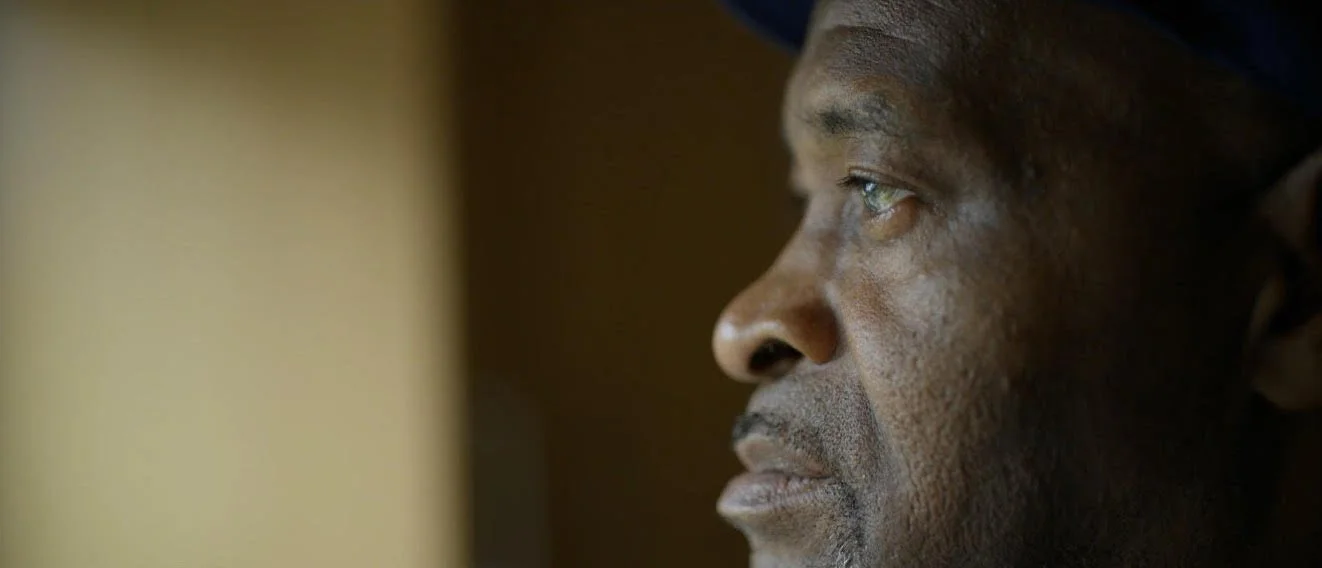
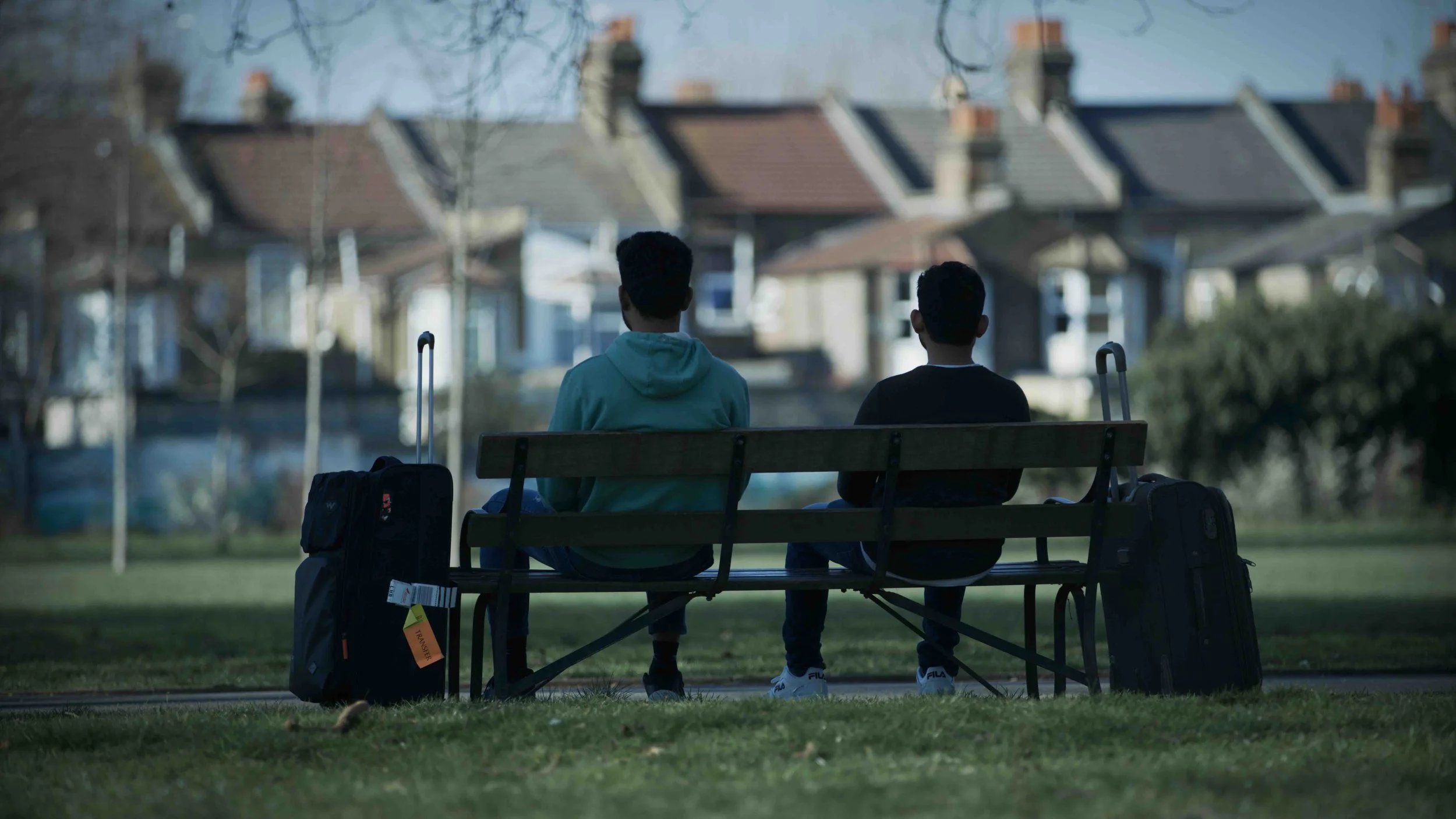
With regards to the first point, the stakes are high. Farrukh Sair, an NHS IT Engineer has spent tens of thousands of pounds on visa applications and is still waiting for settled status Anthony Bryan, a member of the Windrush generation, has not recovered from detainment due to a lack of paperwork, in what became to be known as the Windrush Scandal. International students, now destitute, face deportation, and community organisers are struggling to feed these vulnerable communities without government support.
Hearing stories directly from those who are deeply affected by these issues, we open the doors to show what the real-life effects are for those trying to navigate their everyday lives in a hostile environment.
What does it mean to be British? How does it feel to be told you don’t belong?
Regarding the second point, we look at the history and development of immigration laws and how they were rooted in specific eras, like the end of the British Empire and the Partition of India, and how this impacted people on a personal level.
We utilise archival footage to depict this history as well as charting the UK’s immigration policies over recent years to inform on how we arrived at the situation we’re in today.
The Partition example is particularly relevant to me. The participant I interviewed in the film is my mum (the interview was conducted before I began to make Hostile). It was a particularly difficult moment during the editing process. My mother passed away during the edit of Hostile, so I still had feelings that were quite raw.
So revisiting these stories was not an easy thing, but it was important to do. I feel like sometimes you can think of an event like Partition and not really feel its relevance or impact on the world we live in today. In my mother’s recollections, however, I found a way to link the story of Partition to our present day and I hope that it was able to provide a wider context to the immigration policy debate.
We also look at how specific laws, such as the Points Based Immigration System which was inspired by Australia’s immigration framework, are interconnected, and lead to the global refugee crisis that we are seeing today.
This is evident in the huge number of refugees and asylum seekers seeking refuge taking huge risks crossing borders and oceans by boat in the hope of securing a better life.
To conclude, when we finished making Hostile we couldn’t imagine how things could get any worse. But we have since learned of the government’s plans to deport refugees to detention centres in Rwanda, with the first deportation flight scheduled on June 14th.
This does not bode well for the future of our immigration laws, and the impact it will have on individuals and families will be enormous.
Hostile
How have the script and film evolved over the course of their development?
We had a number of iterations of the script, 23 in fact. The first phase during filming was all about learning and exploring the issues. From there, in the edit room, we honed into the story weaving the present with the past. Our final delivery was a 97 minute film which includes a mix of actuality, interviews and archive.
Filming:
As I touched on above, the film started out as an exploration about how migrant communities in the UK were coping with the impact of the lockdowns during the early stages of the pandemic. I was interested in this because of my own memories growing up in such communities.
It was during this process, and seeing what our participants were living through day-to-day, that I learned about the hostile environment and its impact.
From a larger perspective, what was interesting to me about the process of making this film was filming while so much change was happening in real time. 2020 and early 2021 was a very politically active time, with the global protests that began after the murder of George Floyd, and which were accompanied by Extinction Rebellion protests and NHS Fair Pay protests.
From the other perspective, Brexit negotiations were ongoing, and government policy on a whole number of issues was, for a long time, up in the air.
During filming, the participants' situations were constantly changing, while the policies and legislation whose development formed the structure of the film was also constantly evolving. And this was all against the backdrop of the deteriorating situation due to the pandemic.
Edit:
This evolution was a challenge, especially during the edit, as we had to be really alert to constant changes in the debates that were going on, as well as changing legislation. We had to translate these in a way that we wanted to be relevant a year or two later when audiences would actually watch the film. Our initial cut was three hours long, and we had to do a lot of work to shape the narrative and streamline it.
It was during this process when I came to see that the hostile environment didn’t just come about out of thin air, but it had its own history. And this is something I wanted to explore further, by going back through history and charting its development over time.
Delivery:
This overall process of making this film began in May 2020 and was completed in September 2021, and we are very happy with the way it turned out.
What type of feedback have you received so far?
The response has been very positive.
It premiered at Raindance Festival 2021 in the ‘Homegrown’ category, and soon after it was longlisted for a 2022 BAFTA for Outstanding Debut By A British Writer, Director Or Producer, as well as three 2021 British Independent Film Awards - Best Documentary, Best Debut Director and the Raindance Discovery Award.
It has since been an Official Selection at the Cambridge Film Festival 2021 and London Migration Film Festival 2021, and Winner of Best Documentary Feature at the South London Film Festival 2021. It recently played in competition at the Manchester Film Festival, and screened at ZagrebDox 2022 and will soon play at the Melbourne Documentary Film Festival and Roxbury International Film Festival.
A Q&A tour for the film which is taking place in cinemas across the UK as well as other community venues began on January 21st and is still going strong.
We have had some fantastic hosts (like UK film critic Jason Solomons and director Ursula Macfarlane), and high profile speakers like human rights activist Bella Sankey, Yasmine Ahmed (UK Director of Human Rights Watch), author Maya Goodfellow, and more, who have enthusiastically endorsed the film.
Meanwhile, our Q&As have provoked some really insightful responses and debates from the audience and we hope that Hostile can really help to open up vital conversations around migrants rights and how we can inspire positive change. Individuals in the audience have been very open in sharing their personal experiences living under the Hostile Environment. Since the film’s release I have been hearing from people all around the UK about the impact it has on our communities.
Critics have reviewed Hostile in The Guardian (Peter Bradshaw), The New European, Gal-Dem, Timeout, Morning Star and The Upcoming to name a few.
On March 15th I have also been invited to screen Hostile at the BFI as part of ‘The Camera is Ours’ - a series of films celebrating pioneering female documentary makers from the 1930s til now. The event is going to be hosted by former Channel 4 news anchor Jon Snow, who has described the film as “An important and revealing film with critical questions and revelations about UK society in the 21st Century.”
Recently, the film played in front of lawmakers in the UK’s Parliament where the film was well received and inspired some critical debate, and we are developing plans to screen the film at the UN in Geneva later this year.
Hostile
Has the feedback surprised or challenged your point of view?
The feedback was surprising in that, while I knew that the subject of immigration in the UK had not been tackled in quite the same way (i.e. one which delved into the historical development of ‘hostile environment’ policies), it was still unclear whether people would be interested in hearing about it. So the interest in the film from audience members was pleasantly surprising. Especially as a debut director.
With regards to my point of view, that is debated with every screening.
The issue of immigration is a sensitive one for many people, and the solutions are not easy.
I have taken these different points of view into consideration when discussing the film and its impact, including with the UK’s Chancellor of the Exchequer Rishi Sunak, whom I met at an event at 11 Downing Street where I was able to discuss the No Recourse to Public Funds policy which prevents migrants from accessing public benefits.
So I recognise the complexity of these issues. The primary argument that I make, in the film and in discussions that follow, is that we can come up with solutions that at least take common sense approaches that are rooted in maintaining dignity and integrity for anyone who has either been welcomed into a country by its government, or arrives because they are fleeing persecution or danger of some kind.
What are you looking to achieve by having your film more visible on www.wearemovingstories.com?
I think We Are Moving Stories is a wonderful resource for filmmakers and audience members. We are living in a time when a lot of people from different backgrounds are able to share their experiences, which is a great thing. At the same time, there is so much content that it is easy for these stories to get lost in the mix.
We Are Moving Stories is a great solution for this, and we hope that it will help ensure our film remains a part of the conversation with regards to the themes of migration we are exploring.
Who do you need to come on board (producers, sales agents, buyers, distributors, film festival directors, journalists) to amplify this film’s message?
The film is currently still showing in cinemas in the UK, but will soon be on an SVOD platform in the UK, and has sold to a distributor in Norway. Our next step will be to partner with distributors in other territories as the theatrical run comes to an end.
We will begin by focusing on the European Market, with the US and Australia also being a part of our distribution plan. We are ultimately seeking distribution worldwide
With regards to journalists, we have already had some great responses in the UK. Amelia Gentlemen, who broke the Story of the Windrush Scandal that we examine in the film, used the documentary to further explore issues related to the Hostile Environment in a separate write up for The Guardian.
It would be great to get these messages out via news outlets in different countries to get our film’s message out to as wide an audience as possible.
Hostile
What type of impact and/or reception would you like this film to have?
Our goal for this film has always been to have an impact beyond the initial screening. We created an impact campaign which is all about bringing about awareness of the issues in the film, and seeking solutions to them.
As a part of this, we are hosting community screenings across the UK, and have recently screened the film in front of lawmakers in the UK’s Parliament (with a planned UN screening later this year).
We are also planning a petition for MPs to reconsider some of the more strict rules we have when it comes to offering public support to migrant communities.
Our end game is to open up this discussion to people who have real power to make a difference, in order to bring about actual policy change.
Our targeted goal is to have lawmakers assess the impact of the No Recourse to Public Funds Policy, which prohibits most migrants from accessing public funds. During times of crisis, such as the pandemic had severe economic consequences, this can often lead to destitution.
Almost 1.4 million people who are subject to immigration control have NRPF. 84% of them are currently working or studying. Nearly a quarter of a million of them are key workers. And it is estimated that 175,000 of them are children.
Following a review, we hope the government will eventually reconsider the implementation of this policy.
You can learn more about our campaign on our website: www.hostiledocumentary.com/impact
What’s a key question that will help spark a debate or begin a conversation about this film?
The key question that I think helps people to more deeply consider the issues at stake is one we developed during production, and became one of the ways we organised the structure of the film.
The question is: what happens when the ‘hostile environment’ - which is the set of increasingly draconian immigration policies that target migrants - turns on us all?
It is something we have started to see with the passing of successive bills in the UK which systematically strips citizens of their rights and is in our eyes the best way to start the debate on these issues by making audience members more empathetic to the plight faced by migrants.
What other projects are the key creatives developing or working on now?
In 2015, I produced a documentary called Andrew Carnegie: Rags, to Riches, Power to Peace, narrated by Brian Cox. I am now developing the Andrew Carnegie story into a limited series, with Brian Cox in the lead role and serving as EP.
I have teamed up with renowned tour manager Theo London to co-produce a music documentary centred on the female artists who inspired a music icon, directed by the Emmy Award-winning Geeta Gandbhir. Alongside this, I am developing a hip hop documentary set in India, with the Oscar-nominated Smriti Mundhra and Jerry Henry as directors, and co-produced by the award-winning Shelby Stone and Derek Dudley of ID8 Multimedia.
As a director, I am developing my next documentary which focuses on the history of India. I am also writing a script and developing my first narrative short centred around the day my father died when I was a child.
Interview: June 2022
We Are Moving Stories embraces new voices in drama, documentary, animation, TV, web series, music video, women's films, LGBTQIA+, POC, First Nations, scifi, supernatural, horror, world cinema. If you have just made a film - we'd love to hear from you. Or if you know a filmmaker - can you recommend us? More info: Carmela
Hostile
Length:
1:37:15
Writer/Director/Producer
Sonita Gale is an independent producer and director.
Her directorial debut HOSTILE was longlisted for the BAFTAs in 2022 and three British Independent Film Awards.
Her first project with Galeforce Films was the documentary Andrew Carnegie: Rags to Riches, Power to Peace.
Upcoming projects include a music documentary directed by Geeta Gandbhir, a drama on Andrew Carnegie with actor Brian Cox, and a hip-hop documentary set in India, directed by Smriti Mundhra and Jerry Henry.
Key cast:
FARRUKH SAIR (DOCUMENTARY PARTICIPANT), ANTHONY BRYAN (DOCUMENTARY PARTICIPANT), DAKSHA VARSANI (DOCUMENTARY PARTICIPANT), PARESH JETHWA (DOCUMENTARY PARTICIPANT)
Looking for:
distributors, sales agents, buyers
Twitter:
Facebook:
www.facebook.com/galeforcefilmsUK
Instagram:
http://instagram.com/hostiledoc
Hashtags used:
#hostileenvironment #hostile #documentary #windrush #highlyskilledmigrants #migrantsrights #windrushscandal #documentaryfilm #activism #impact #community #ukfilm #ukdocumentary #hostiledoc #galeforcefilms
More info:
Where can I watch it?
Melbourne International Film Festival - July 1 - 31
Melbourne Documentary Film Festival - July
VG TV Norway - June 17th, 2022 onwards