We are moving stories

  • 3500+ films
  • Alphabetical
  • Black Lives Matter (1)
  • Black Lives Matter (2)
  • Black Women's Voices (1)
  • Black Women's Voices (2)
  • LGBTQIA+
  • Lesbian (1)
  • Lesbian (2)
  • Gay (1)
  • Gay (2)
  • Queer (1)
  • Queer (2)
  • Queer (3)
  • Bisexual
  • Intersex & Asexual
  • Love Sex
  • Trans (1)
  • Trans (2)
  • LatinX (1)
  • LatinX (2)
  • LatinX (3)
  • FilipinX
  • Asian American
  • First Nations
  • Kids
  • Mothers
  • Daughters
  • Fathers
  • Teens
  • Coming of Age
  • Gen Z
  • Gen Z / Millennials
  • Millennials
  • Romance
  • RomCom
  • Comedy
  • Thriller
  • Action
  • Western
  • Zombies!
  • Horror (1)
  • Horror (2)
  • Other Worlds
  • Supernatural
  • Fantasy
  • Scifi
  • Technology
  • VR
  • Social Media
  • Women & Animation (1)
  • Women & Animation (2)
  • Artists
  • Musicians
  • Dancers
  • Fashion
  • Mental Health (1)
  • Mental Health (2)
  • Disability (1)
  • Disability (2)
  • COVID-19
  • Migration
  • Refugees Welcome
  • Holocaust
  • Democracy
  • Gun Violence
  • Climate Crisis Solutions
  • Food
  • Cities
  • Home/less
  • Faith and Spirituality
  • #metoo
  • Rape Culture
  • Right to Choose
  • Award-winning
  • Sundance
  • Hollywood
  • Actors
  • Canada
  • Quebec
  • Pasifika
  • French Cinema
  • New Italian Cinema
  • Germany
  • Russia
  • UK
  • Australia
  • New Zealand
  • China
  • South Asia
  • India
  • MENA - Middle East/North Africa
  • Surfing
  • Sport
  • Adventure
  • Drugs
  • Addiction
  • Hip Hop
  • Subcultures
  • Cats and Dogs
  • Animals
  • Environmental
  • AFI Conservatory
  • Filmmakers to Watch (1)
  • Filmmakers to watch (2)
  • Members FAQ
  • why now
  • New Projects
  • Film Finder
  • Database
  • TOS
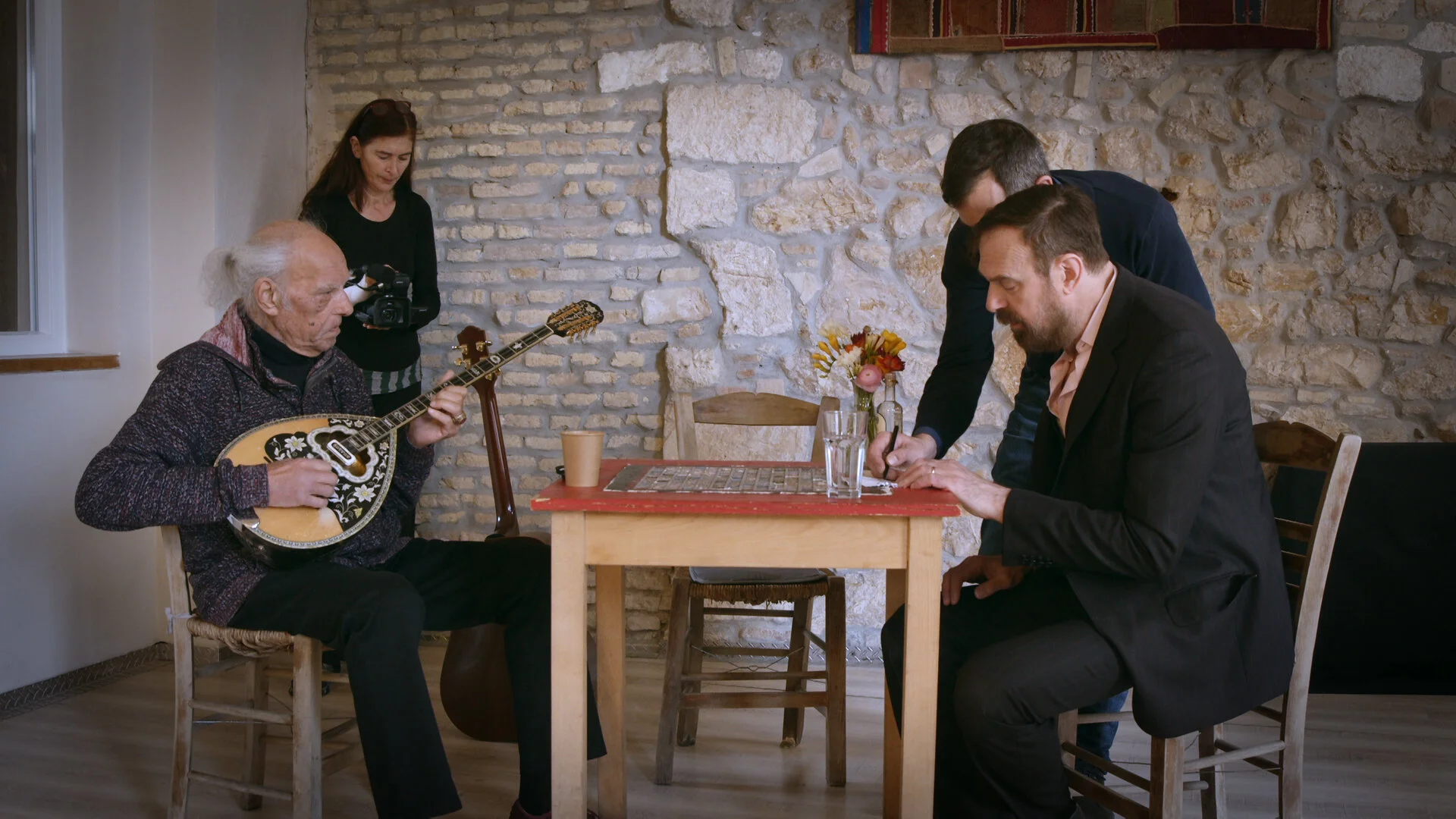
SteliosJim00014375.jpg

MDFF 2021 - My Rembetika Blues

July 15, 2021 by Carmela Baranowska

A film about love, life and Greek music

Interview with Director M.Zournazi


Congratulations! Why did you make your film?

I became interested in Rembetika music whilst I was filming my first film, Dogs of Democracy in Greece. I was struck by a story I heard about Syrians and Greek dancing to Rembetika together. It made me think how music can connect people together in times of difficulty and hardship. At the time, the Greeks were living through an economic and humanitarian crisis and the Syrian refugees were fleeing the civil war in Syria.

Rembetika music or the Greek blues is a music born of exile and the streets. It also developed out of mass migration of people in the early twentieth century and into an urban style blues.

In this way, my film is a response to mass migration and displacement across history and countries, and how music is a means of expression and testimony to these experiences.

Imagine I’m a member of the audience. Why should I watch this film?

For the love of music and for an insight into our common humanity.

How do personal and universal themes work in your film?

Totally. The film is a personal journey exploring the universal themes of love, loss and belonging.

How have the script and film evolved over the course of their development?

Yes, indeed. I started with a different story in mind & it evolved through the countries and wonderful interviewees/characters I spoke to. Including wonderful performers such Jim Sclavunos from Nick Cave and the Bad Seeds, and the master of Rembetika music, Stelios Vamvakaris.

What type of feedback have you received so far?

The feedback has been very positive. I've watched the film with non-Greeks, who really appreciated the introduction to a genre of music they'd never heard of before and with Greeks - who were dancing in the isles. For Greeks and Greeks in the diaspora, the music and story touches them deeply. I've also been struck by younger people who really identify with the journey of the film itself.

Has the feedback surprised or challenged your point of view?

I've been pleased and heartened that people have responded to the film in such a positive way. The movie was made with no real budget but with a lot of heart and soul. I feel that I have succeeded in telling a very important story about our common humanity and that people can relate to it.

What are you looking to achieve by having your film more visible on www.wearemovingstories.com?

To help people be interested in these stories of migration and the intergenerational experiences that we all face as we try to live and navigate the world in which we live in! I hope, too, they will watch the film!

Journalists and other film festival directors, as well as buyers/broadcasters would be very helpful to get the film out into the world. Also, I'm keen for local screenings and Q& As. I love watching the film with audiences.
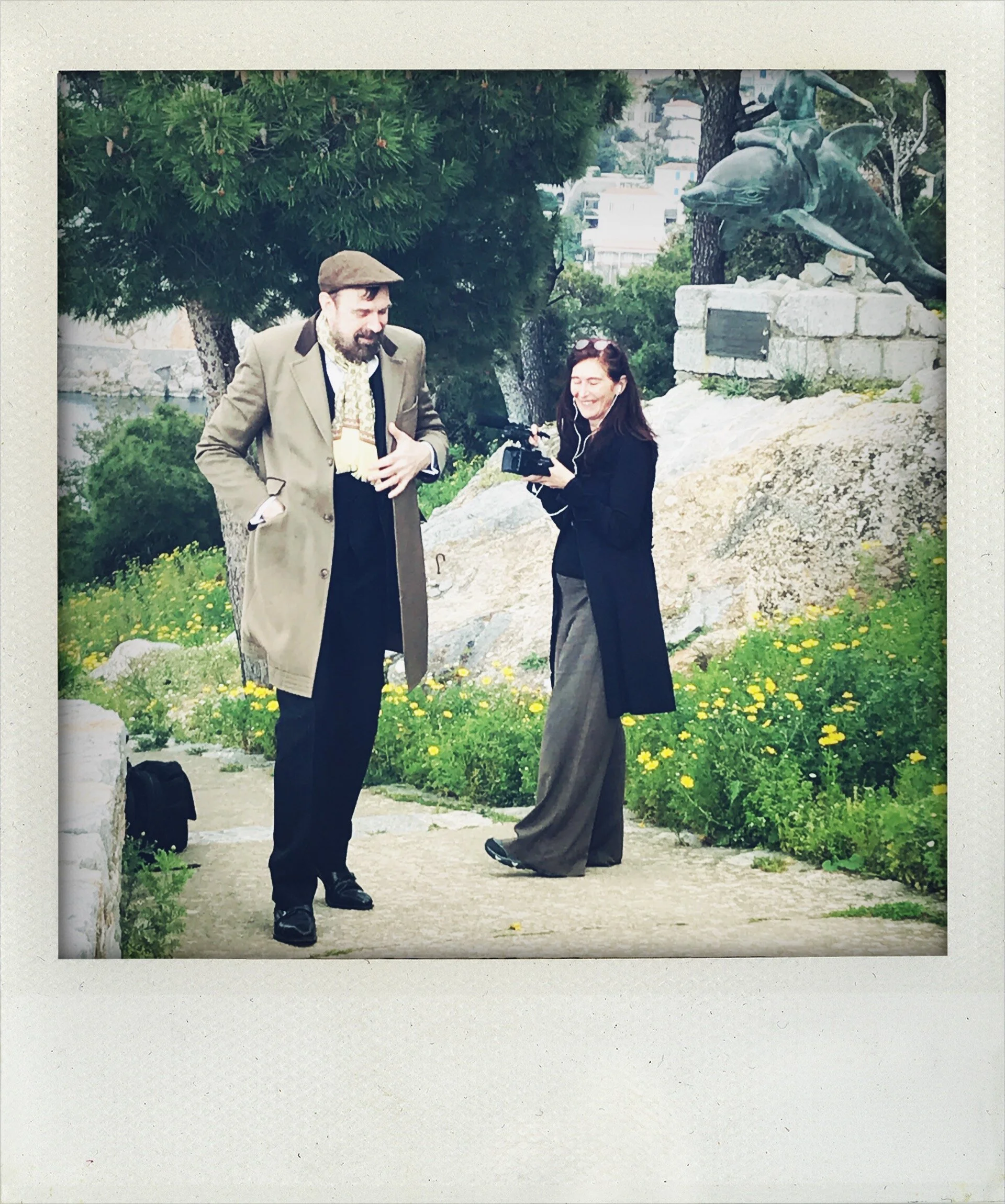
My Rembetika Blues - Director M.Zournazi with Jim Sclavunos photo credit: Sarah Lowe

My Rembetika Blues - Director M.Zournazi with Jim Sclavunos
photo credit: Sarah Lowe

Who do you need to come on board (producers, sales agents, buyers, distributors, film festival directors, journalists) to amplify this film’s message?

Journalists and other film festival directors, as well as buyers/broadcasters would be very helpful to get the film out into the world. Also, I'm keen for local screenings and Q& As. I love watching the film with audiences.

What type of impact and/or reception would you like this film to have?

I would like the film to reach as many people as possible - to share the legacies of our histories and to provide a means to enable different kinds of generosity and social healing.

What’s a key question that will help spark a debate or begin a conversation about this film?

One of the key lines in the film is that 'Music has no borders' - that's the starting point to think about our common humanity.

Would you like to add anything else?

Thank you for your time - I hope people can share the film and the love for the Rembetika music!

What other projects are the key creatives developing or working on now?

I have a couple of projects in the pipeline - my next immediate project is a documentary film - relating to Greece and animals, and to the experience we are living through right now in these COVID times. I also have a fiction film in mind with my collaborator and friend the Australian author Christos Tsiolkas.


Interview: July 2021


We Are Moving Stories embraces new voices in drama, documentary, animation, TV, web series, music video, women's films, LGBTQIA+, POC, First Nations, scifi, supernatural, horror, world cinema. If you have just made a film - we'd love to hear from you. Or if you know a filmmaker - can you recommend us?  More info: Carmela


My Rembetika Blues

Length:

1:23:00

Writer/Director

M. ZOURNAZI is an Australian film maker, author and philosopher. Her multi-awarding winning documentary Dogs of Democracy (2017) was screened worldwide. Her most recent documentary film, My Rembetika Blues is a story about love, life and music. She is the author of several books including Hope - New Philosophies for Change, Inventing Peace with the German filmmaker Wim Wenders and most recently Justice and Love with the former Archbishop of Canterbury, Rowan Williams.. She is Associate Professor in the School of Sciences at the University of New South Wales, Australia.

Producer

TOM ZUBRYCKI is an Australian filmmaker whose award-winning documentaries have for the past 40 years mapped this nation’s changing social and political landscape.

Looking for:

Journalists, Buyers, Film Festival Directors

Facebook:

https://www.facebook.com/rembetikablues/

Hashtags used:

#rembetika, #rembetiko, #greek music, #greece, #documentary film, #the blues

More info:

https://documentaryaustralia.com.au/project/rembetika-blues/


Where can I watch it now?


July 15, 2021 /Carmela Baranowska
Comment

Focus on AFI Conservatory - Your One and Only

July 15, 2021 by Carmela Baranowska

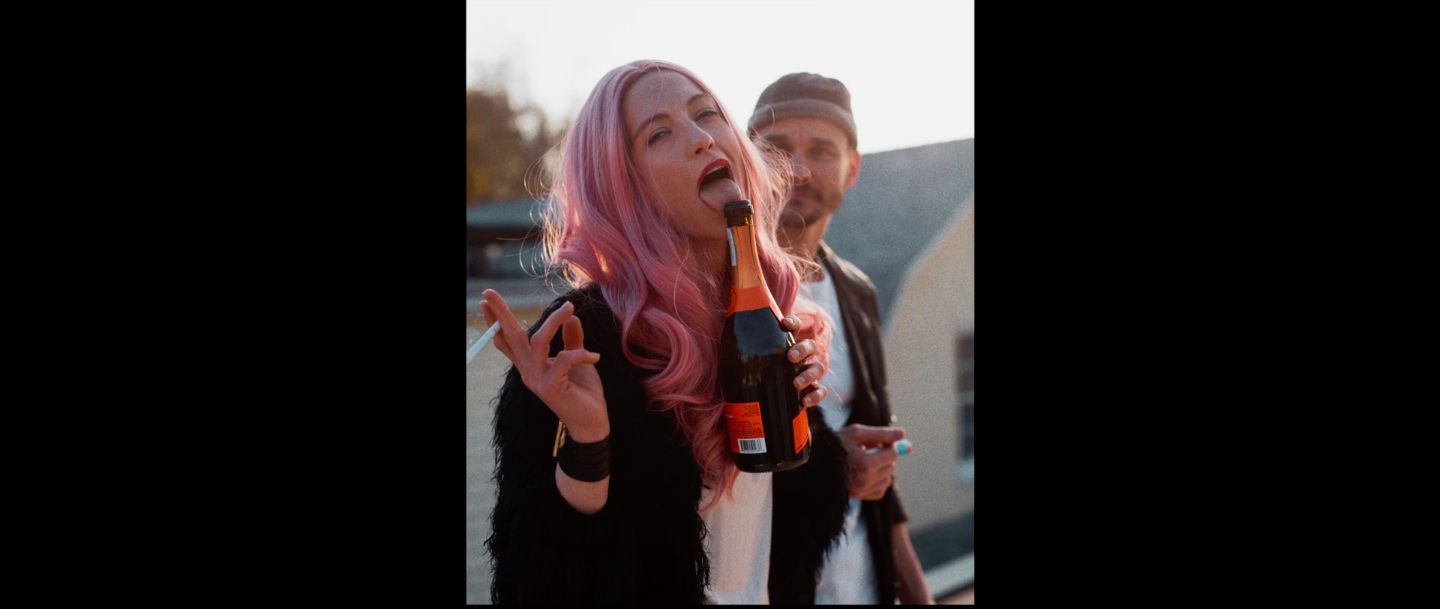
Returning home after an abortion, Sophie finds her husband cheating on her, overwhelmed, she invites his mistress to lunch in order to take her revenge.

Interview with Writer/Director Alice Biletska

Watch Your One and Only here:


Congratulations! Why did you make your film?

I was with my ex-husband for ten years. We managed to break up and get back together ten times, and got married and divorced once. We lived in different cities, countries, continents, but still could not let go. Our marriage was like “Killing Eve” or “My King”. In my experiential vocabulary, love and hate often meant the same thing. Which is sexy, obviously, but also very unhealthy. When we were breaking up the final time, our neighbors called the police, afraid that we would kill each other.

As with any beautiful experience, this taught me a lot. First and foremost, know your boundaries and never sacrifice what’s important to you. A lot of women, just like me, were raised to please men, often in ways that contradict our own needs. But f*** that. It’s not love, it only kills it.

So for me this film is about a woman, who is so desperate in her sacrifice, that she loses touch with her own instincts and body, but ultimately is able to regain enough perspective to see the whole picture and let go of her inner toxicity.

Imagine I’m a member of the audience. Why should I watch this film?

As with any film, one has a chance to be an observer, with a bit voyeuristic preferences if you must, to forget his/her own life and emerge into a raw and juicy experience the film has to offer. And many times, the viewer has a chance to learn something about themselves and the world that might make them a more complex and fulfilled human being.

Your One and Only

Your One and Only

How do personal and universal themes work in your film?

Every film is a writer's and director's personal interpretation of a universal theme.

How have the script and film evolved over the course of their development?

I had around 10,000 drafts of the film. And in my head there were even more versions of it. First and foremost it was a phenomenal learning experience for me - for the first time I was doing something very personal, yet in a genre form. I'm very grateful to my mentors and my team at AFI who went all the way with me. Along the way it changed a lot: from fantasy short film set in the underworld, flooded with frogs and snakes, it shifted into reality and became a psychological thriller. But the core always remained the same - I wanted to tell a story about toxic love, sacrifice, loosing sanity and finally seeing the light in the end of the tunnel.

What type of feedback have you received so far?

Very different. Which makes me very happy - it means that the film worked. If you are getting the same reaction from everyone, you are doing something wrong.

What are you looking to achieve by having your film more visible on www.wearemovingstories.com?

I would love people to question what is healthy love, what is toxic love, how far they can go for the ones they love and when is it better to stop and let go.

Your One and Only

Your One and Only

Who do you need to come on board (producers, sales agents, buyers, distributors, film festival directors, journalists) to amplify this film’s message?

Everyone!

What type of impact and/or reception would you like this film to have?

I would like for it to provoke a conversation about love. We have to learn how to love and value ourselves in a very healthy and caring way. And only after that try to love someone else. Otherwise, one will make the same mistakes the protagonist does.

What’s a key question that will help spark a debate or begin a conversation about this film?

Is love worth dying for?

Interview: July 2021


We Are Moving Stories embraces new voices in drama, documentary, animation, TV, web series, music video, women's films, LGBTQIA+, POC, First Nations, scifi, supernatural, horror, world cinema. If you have just made a film - we'd love to hear from you. Or if you know a filmmaker - can you recommend us?  More info: Carmela


Your One and Only

Length:

17 minutes

Writer/Director

ALICE BILETSKA holds a bachelor's degree in Economics, and a master's degree in Fine Arts. During university years, she worked as a freelance journalist, curator and lecturer. While studying for a semester in Paris, she was exposed to an avant-garde theatre, and started both directing and acting. Coming back home to Ukraine, she wrote and directed her first theatre play, and in 2015 switched to cinema and started directing and writing short films and commercials. Her films were presented at such festivals as VAEFF, Cannes Film Festival Short Corner, OIFF and others. She also continued teaching and, in 2017, joined Borys Grinchenko Kyiv University as a lecturer in the field of visual culture. In 2020 she graduated from AFI Conservatory as a directing fellow, having shot and co-written 5 short films.

Producer

Thomas Hartmann

Key cast:

CAITLIN GERARD (Sophie), TRAVIS HAMMER (Will), CHLOE RAY WARMOTH (Marsha)

Social media:

https://www.facebook.com/alice.biletska/

https://www.instagram.com/madam.o/

Made in association with:

AFI Conservatory


July 15, 2021 /Carmela Baranowska
Comment

MDFF 2021 - Overdosed

July 14, 2021 by Carmela Baranowska

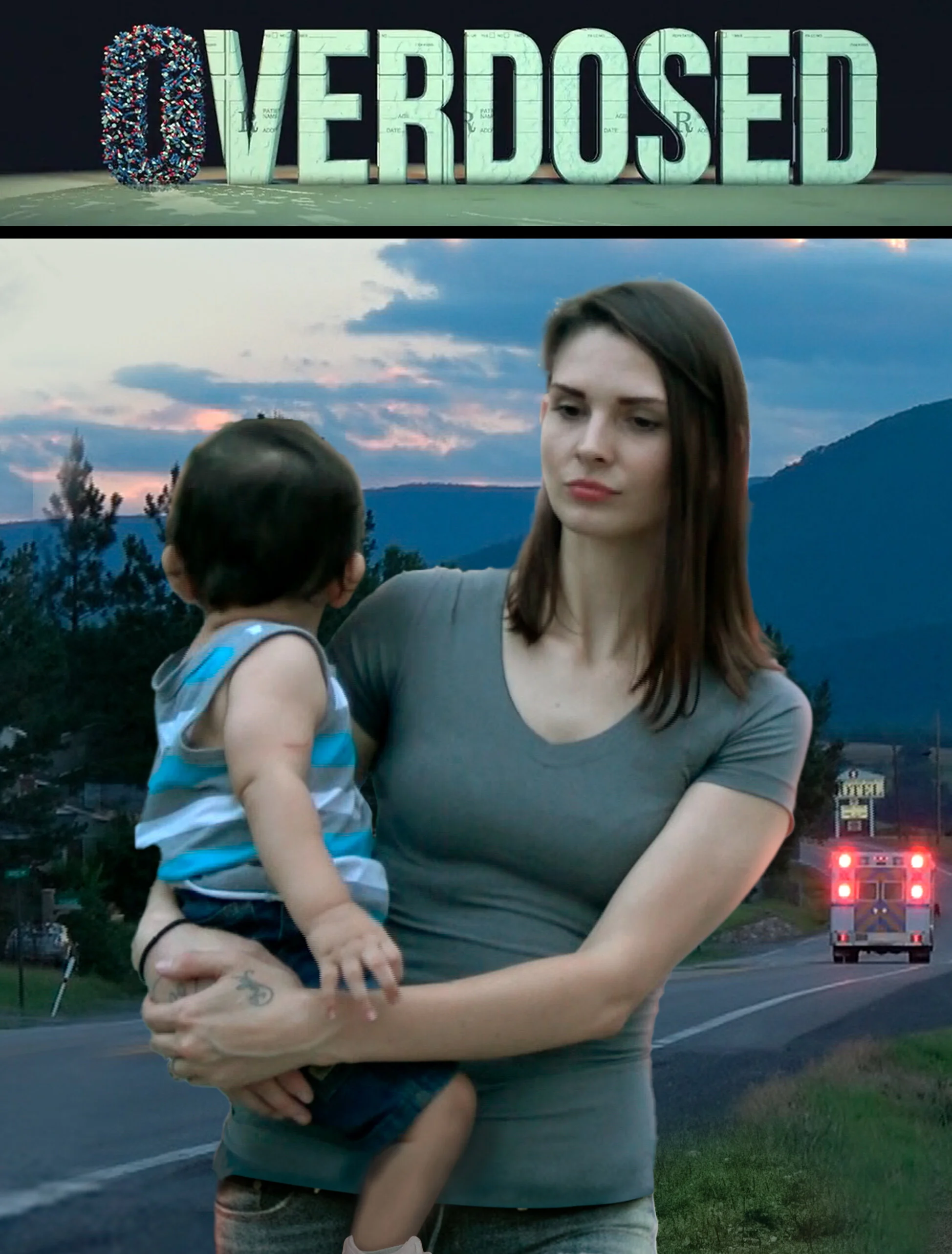
Challenging the stereotype of a drug dealer.

Interview with Director Mary Sue Connolly

Watch Overdosed on Prime Video


Congratulations! Why did you make your film?

I lost my beloved young nephew Paul to an accidental overdose in 2016. This immediately turned my life upside down and I decided to dedicate all of my resources to investigating the sources of the opioid epidemic in the US. I felt that this epidemic was growing in the shadows and affecting millions of people, but there was still very little media attention focusing on this crisis, a crisis that showed no signs of abating. I had no medical training or experience with grassroots organizing, but I did have a video camera and I was a trained editor, so I grabbed my camera and began my journey of investigation into the origins of this man-made epidemic. I did this in the hope that by sharing this story it could prevent other families from suffering as mine had, and that perhaps this film could also expose the callous nature of some of these drug giants, who have shown tremendous greed and clearly thought these lives were disposable.

Imagine I’m a member of the audience. Why should I watch this film?

Overdosed provides viewers access to the corporate, profit-driven dark side of this crisis, while revealing the core humanity of its survivors. The documentary exposes key elements about the rapid progress of this deadly epidemic, and the ways communities are now coping with its destruction. The result is a documentary that will wake you up to the tragedy of a small town ravaged by the epidemic and inspire you to get involved in finding solutions.

How do personal and universal themes work in your film?

The universal theme of greed permeates Overdosed. From the girl on the corner slinging dope, to the executive in one of the largest corporations in the US, it seems to be the connecting thread. While making Overdosed I tried to put my personal story aside but soon realized that rebuilding our communities was one of the greatest tools we have in fighting this epidemic - in fighting corporate greed. Each of us can play a role within our community to implement change, and that is a powerful tool of fighting back.

Overdosed

Overdosed

How have the script and film evolved over the course of their development?

As the film is investigative, I literally had no idea where I was going to end up. It was a process of unravelling for me. I was focusing on a drug dealer in a small town, but was quickly led further up the ladder, ie. to the doctor who was dealing from his doctors office, the pharmacy that was looking the other way and the drug distributor who was shipping millions of doses of pain pills to tiny communities across the country. So essentially this small town story became something much bigger. After getting a wonderful agent from the DEA (Guy McCartney) involved, all of these moving pieces seemed to slip into place.

What type of feedback have you received so far?

The feedback greatly varies depending on your geographical location. In West Virginia, the story comes as no surprise to people, while in countries in Europe, audiences are shocked beyond belief that this kind of corporate drug dealing is happening today, and on such an extensive level. I think people find it shocking and enraging. Also, our main character Breanne McUlty, her personal story is very inspirational. As a teenage drug dealer and a convicted felon - to a whistle-blowing film producer, Breanne is living proof that anyone can turn their life around.

Has the feedback surprised or challenged your point of view?

I was very surprised when I first showed the film in Europe, that this story came as such a shock. It reinforced my eagerness to spread this message, because I realized it still is an untold story in large parts of the world. It is a little like America's dark little secret. As a result I try to engage audiences outside of the US as much as I can in the hope of exposing the corporate greed that led to such despair.

What are you looking to achieve by having your film more visible on www.wearemovingstories.com?

Our mission while making Overdosed was to raise awareness of this huge threat to people across the US, and now across the world. The overdose epidemic is killing 200 people a day in the US. Many of the victims of accidental overdose started innocently on prescription pain pills, some for minor injuries, at a doctors office, but years later find themselves dependent on pain medications to prevent very severe withdrawal symptoms.

As the doctors had to scale back on their prescribing, people turned to the streets. With the rise of fentanyl, the situation has become catastrophic because users are unaware that their drug supply is laced with fentanyl. Fentanyl is a synthetic opioid that is 50 times stronger than morphine. Teens as young as 14 or 15, who would normally experiment with drugs, are now dying from fentanyl laced pills. Their bodies simply do not stand a chance against this poison. I am very grateful to to have this platform to spread this message, about our film and our activism, so thank you so much for asking these questions!

Who do you need to come on board (producers, sales agents, buyers, distributors, film festival directors, journalists) to amplify this film’s message?

While we have a sales agent and a distributor, we would be thrilled with more exposure in the press and at film festivals. Bringing Overdosed to an in-person audience is always a wonderful way to get the conversation going and it is thrilling to be able to answer questions that audience members have. It is also very informative for us on how our film is being perceived. There is still so much that was left on the cutting room floor and it is always fun to resurrect some of those stories.

What type of impact and/or reception would you like this film to have?

I want people to be outraged at the injustice that has been served to so many communities across the US. Entire areas have been ravaged with addiction and are left crumbling and in decline. Litigation with drug companies is ongoing and all of us in this fight are demanding that they be held accountable. I hope that people will join our mission of insisting that drug companies cannot simply buy their way out of this devastation. The opioid epidemic has caused 500k deaths in the US alone and has left a trail of heartbreak. I also think every individual needs to investigate whether they need severe pain medication, that is highly addictive, for routine injuries and why it is being offered to them.

Overdosed

Overdosed

What’s a key question that will help spark a debate or begin a conversation about this film?

If the profit motive was removed from the healthcare sector, would we have better patient care?

Would you like to add anything else?

Thank you to everyone that helped make this film possible. So many people donated their time and resources because they believed so strongly in this message. We are forever grateful for their assistance and for their trust in us to tell this story. For everyone that has been lost to this epidemic, you are not forgotten!

What other projects are the key creatives developing or working on now?

The director is in the development process of a documentary about drug trials that took place within vulnerable populations in the 1970's and 80's.

Interview: July 2021


We Are Moving Stories embraces new voices in drama, documentary, animation, TV, web series, music video, women's films, LGBTQIA+, POC, First Nations, scifi, supernatural, horror, world cinema. If you have just made a film - we'd love to hear from you. Or if you know a filmmaker - can you recommend us?  More info: Carmela


Overdosed

Length:

1:15:00

Director

MARY SUE CONNOLLY is an Irishborn filmmaker and video editor who worked as an Editor/Producer for CNN’s New York bureau and as an Editor at CBS Television Distribution. Mary Sue put her career on hold to create Overdosed after the opioid epidemic impacted her own family. She lives with her young daughter, Meibhin and the family divides its time between County Waterford, Ireland & Williamsburg, Brooklyn.

Producer

After a five-year stint in federal prison, Co-Producer BREANNE MCULTY emerged with a conviction and a desire to make her mark on the world by helping families devastated by addiction. She saw how her own participation in the illicit drug world had contributed to the destruction of her community and she
became determined to give back. When McUlty met director Mary Sue Connolly the two embarked on the documentary Overdosed set in McUlty's hometown of Petersburg, West Virginia.

Key cast:

Breanne McUlty, Jenni Jellerson, GuyMcCartney, Kammie Dolan, Kevin Bowman

Looking for:

buyers, journalists, film festival directors

Social media:

https://www.facebook.com/WeAreOverdosed

https://twitter.com/MarySConnolly

https://www.instagram.com/overdosedfilm/

Hashtags:

#overdosedfilm #opioidcrisis #endoverdose #femalefilmmakers #marysueconnolly

More info:

OverdosedFilm.com


July 14, 2021 /Carmela Baranowska
Comment
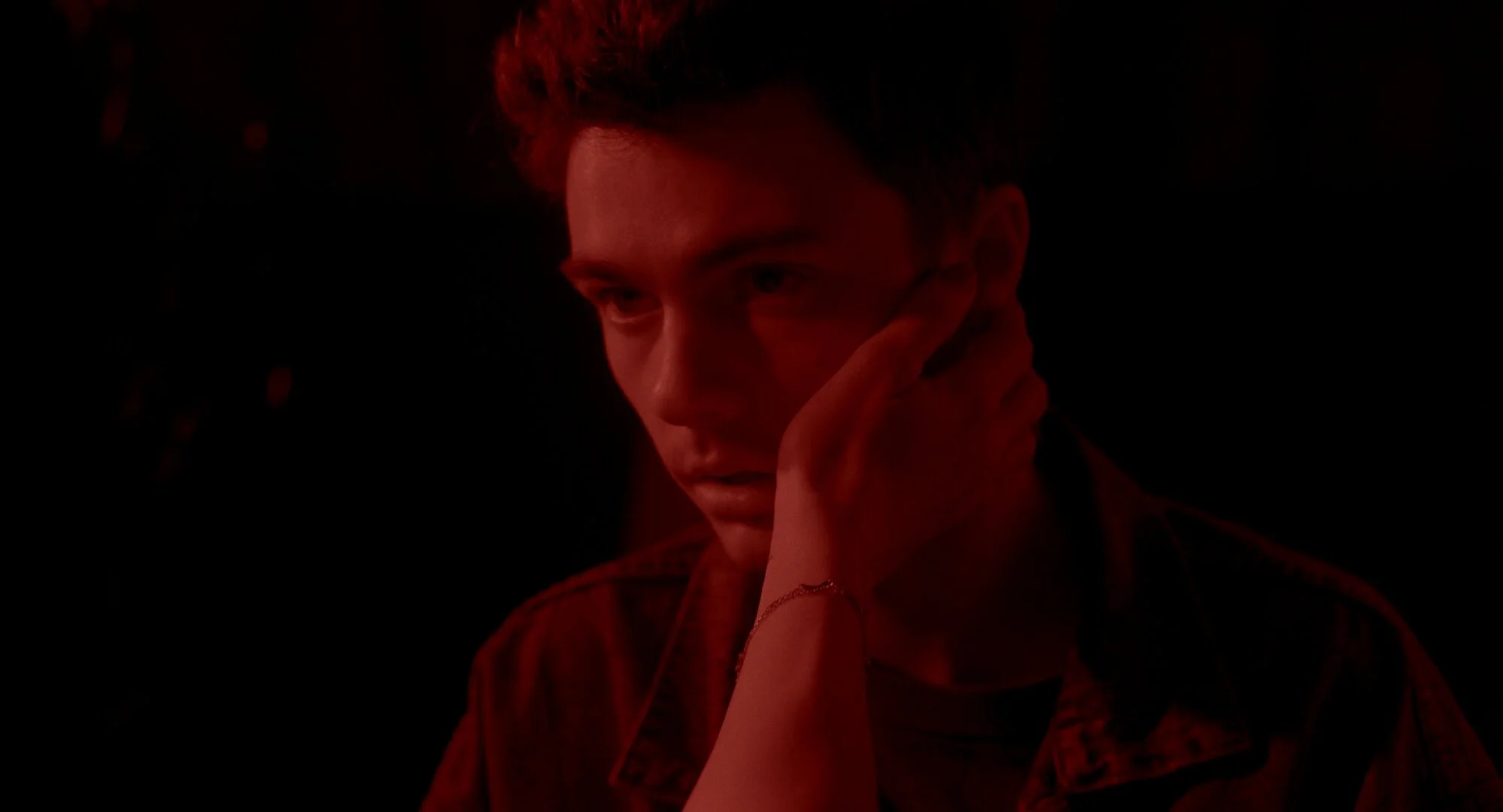
Vincent_Stills_1_2_46.jpg

Focus on AFI Conservatory - Vincent

July 14, 2021 by Carmela Baranowska

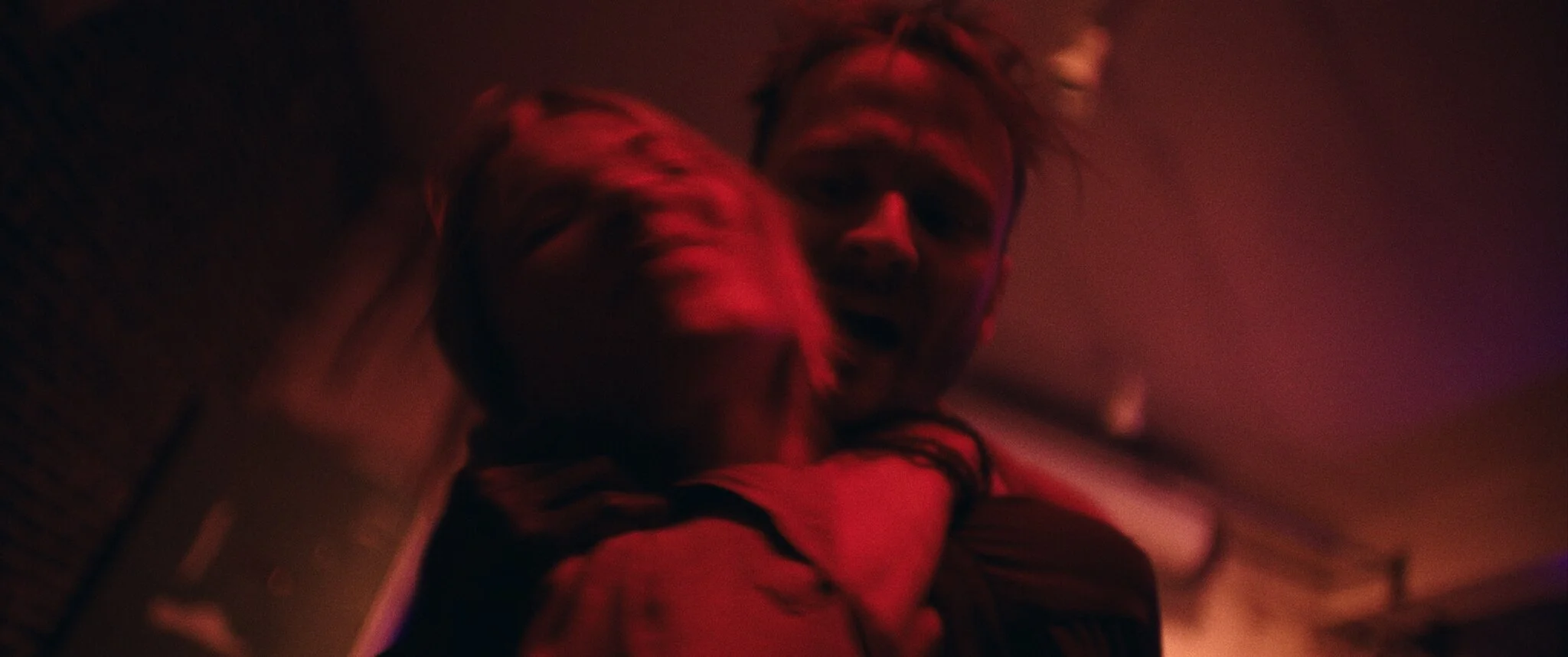
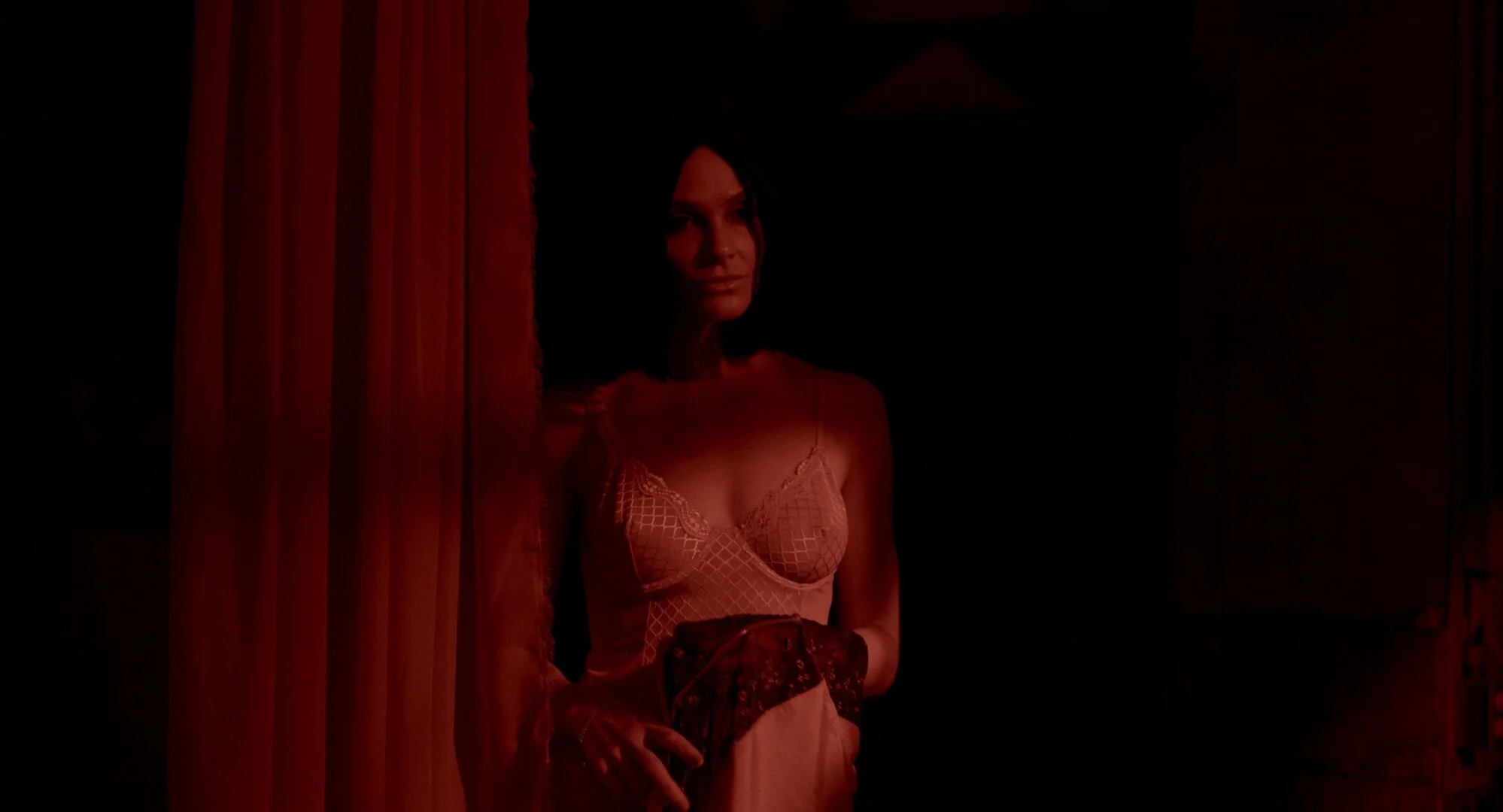
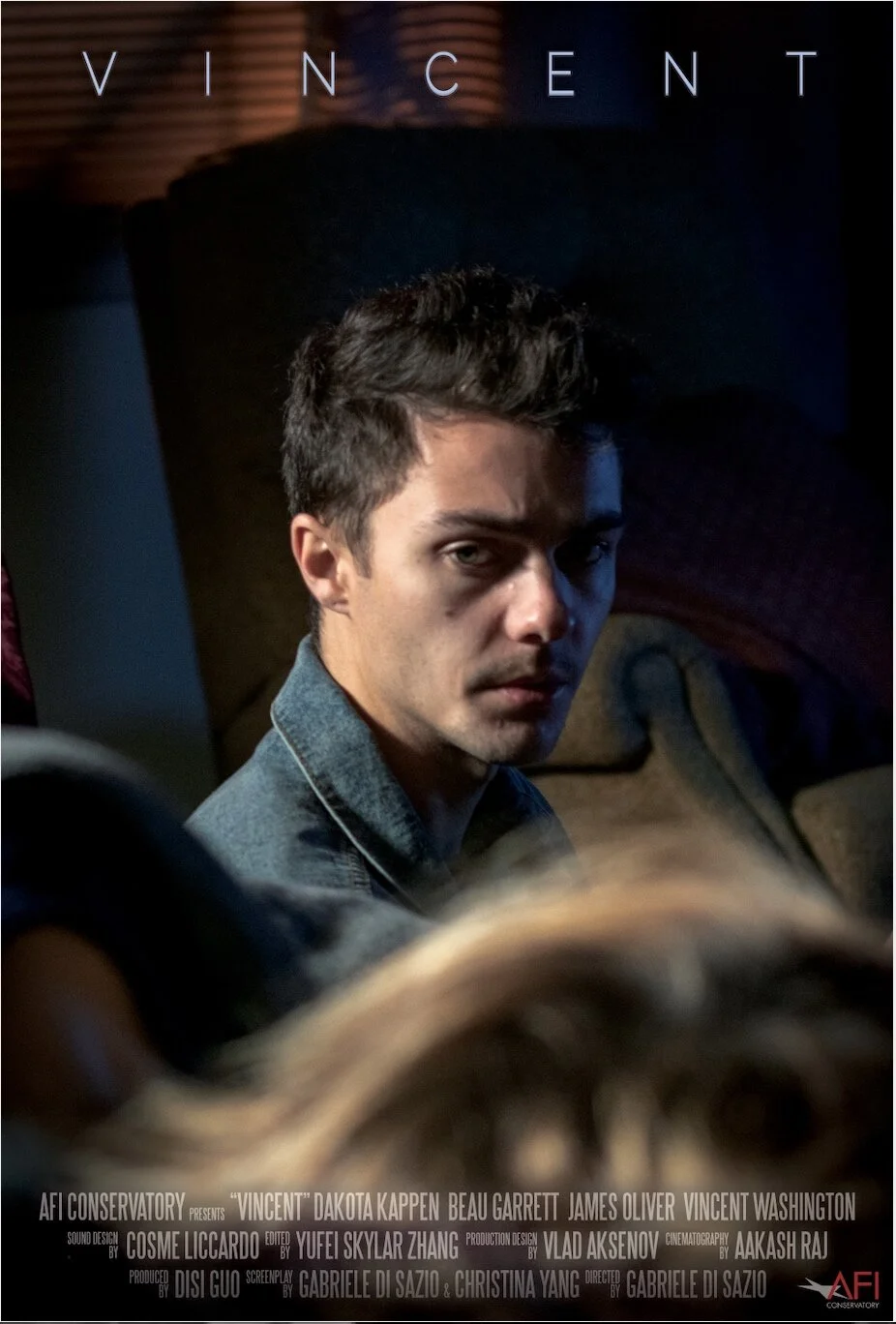
After a visit of his estranged father, followed by a violent argument between his parents, Vincent gets persuaded to follow his friend Bunny to a brothel. Although reluctant about the idea of being there, he enters a room where he meets a figure that seems familiar: a woman that looks like his mother.

Interview with Writer/Director Gabriele Di Sazio


Congratulations! Why did you make your film?

I wanted to explore two elements: the different roles that every person is playing within their families and how sometimes we're forced into roles we don't wanna play. And intimacy; its shapes and its contradictions.

Of course, like every movie I ever made, the fundamental reason was the need and desire to explore myself; my traumas and fears.

Imagine I’m a member of the audience. Why should I watch this film?

I don't really have an answer to this question. I think watching movies takes people on an emotional journey that helps them understand themselves and others. VINCENT is definitively a challenging movie and has been for many. I suppose people should watch it if they also want to be challenged and have the desire to enter the mind of a person that is longing for intimacy and closeness but doesn't know where and how to find it.

How do personal and universal themes work in your film?

To me intimacy means Home. I feel intimate with people or with myself when I feel at home. And if I think about the last few times I felt at home, I can only remember brief moments, some of which my encouraging imagination might even be creating where there aren't any. I'm in continuous search of Home - of those brief moments when I can finally breathe and live in the present rather than the past or the future.

How have the script and film evolved over the course of their development?

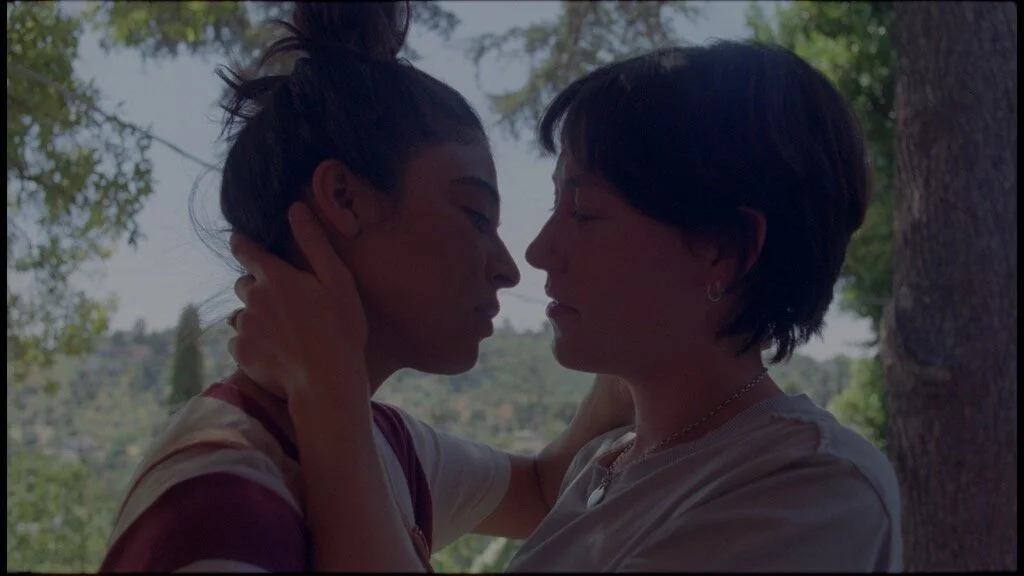
Vincent

Vincent

The film began its journey as a series of chaotic scenes not in chronological order that were just describing Vincent and his life - his reactions to traumas, his relationship with his father and mother, and himself - and would find meaning only at the end. Then it gradually developed into a more classic structure, with a story that takes place over a night.

What type of feedback have you received so far?

Well, the film seems to be either hated with passion and conviction or loved and found moving. This has honestly happened other times with movies I made, but this one was particularly divisive.

Has the feedback surprised or challenged your point of view?

On the surface, the story also deals with incest, or at least a hinted desire for incest. This element was not appreciated by many, although I'm surprised by the unwillingness of trying to understanding the reasons behind certain choices when a movie deals with delicate subjects. It definitively left me with a bitter taste, improved only by the great response of a large portion of the audience.

What are you looking to achieve by having your film more visible on www.wearemovingstories.com?

I have lots of bigger projects in mind - in particular, a feature film and a TV show. I'd like to have more visibility and get in contact with people that will help me with that.

Who do you need to come on board (producers, sales agents, buyers, distributors, film festival directors, journalists) to amplify this film’s message?

The movie already played in several festivals and a few articles have been written about it, but I'd like it to play on a platform and have some more visibility.

What type of impact and/or reception would you like this film to have?

I'd like people to understand a bit more about themselves after watching the movie.

Vincent

Vincent

What’s a key question that will help spark a debate or begin a conversation about this film?

"What does home feel like to you?"

What other projects are the key creatives developing or working on now?

I'm working on a feature film called ALTROVE, which means ELSEWHERE, and it's set between Italy and the States. I'm also developing a tv show idea that has no title yet.


Interview: July 2021


We Are Moving Stories embraces new voices in drama, documentary, animation, TV, web series, music video, women's films, LGBTQIA+, POC, First Nations, scifi, supernatural, horror, world cinema. If you have just made a film - we'd love to hear from you. Or if you know a filmmaker - can you recommend us?  More info: Carmela


Vincent

Length:

19:57

Writer/Director

Gabriele Di Sazio

Key cast:

Dakota Kappen (Vincent), Beau Garrett (Mother/Prostitute), James Oliver (Father), Vincent Washington (Friend)

Looking for:

Journalists, Buyers, Distributors, Sales Agents

Instagram:
https://www.instagram.com/gabrieledisazio/

Made in association with

AFI Conservatory


Made in association with:


AFI Conservatory


Where can I watch it now?


HBOMax


July 14, 2021 /Carmela Baranowska
Comment
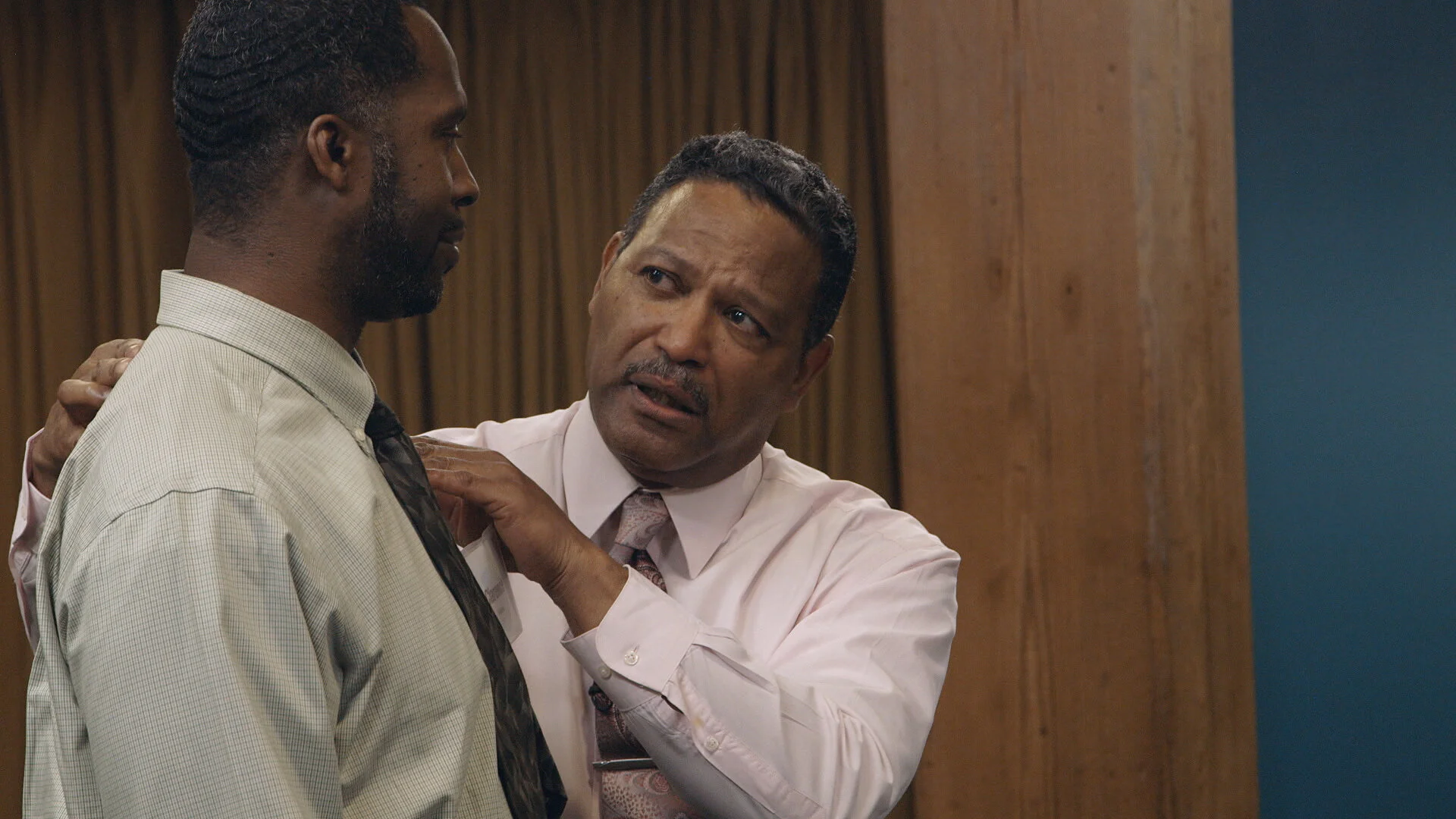
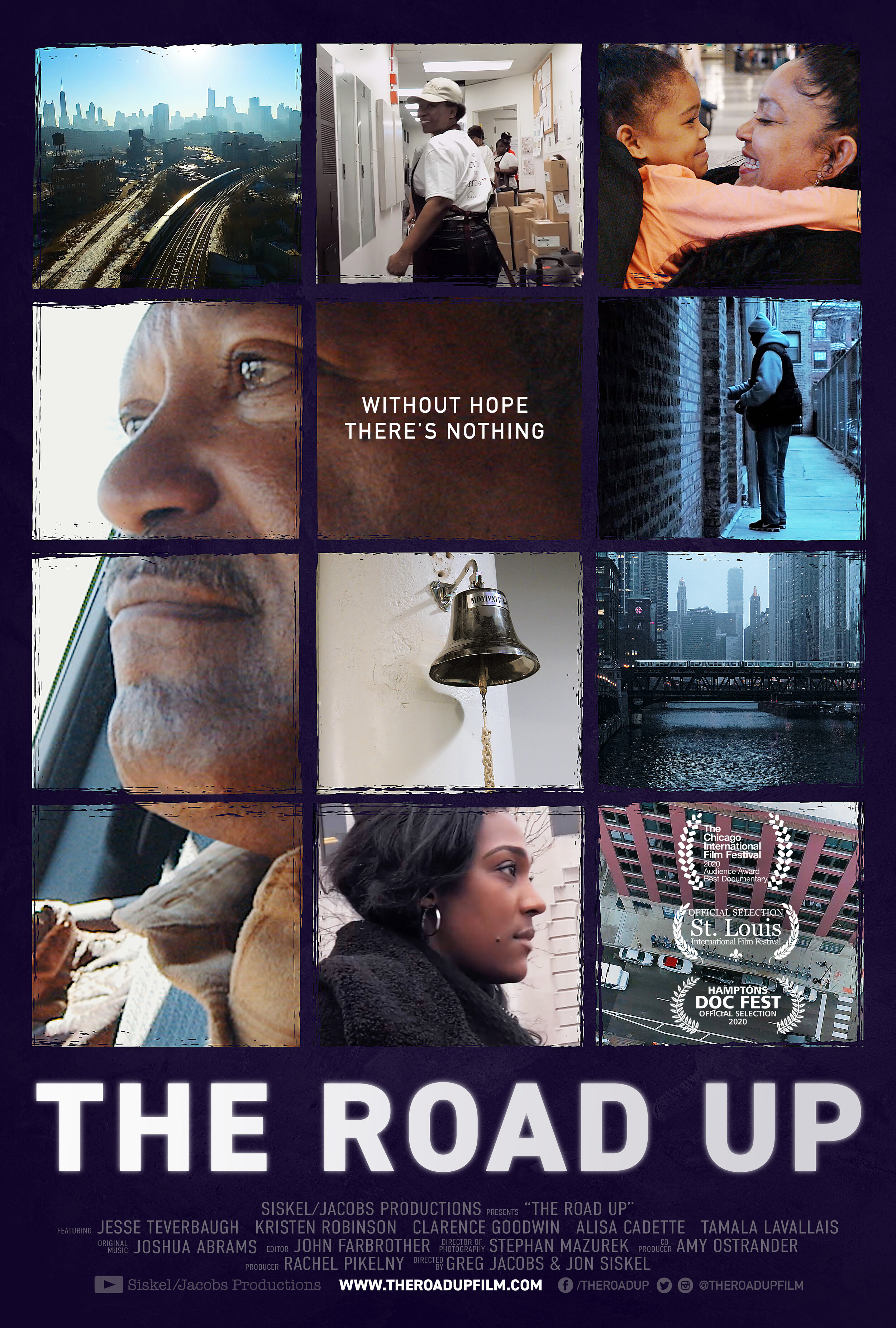
The Road Up - Jesse Teverbaugh and Clarence Goodwin, Transformations

The Road Up - Jesse Teverbaugh and Clarence Goodwin, Transformations

MDFF 2021 - The Road Up

July 13, 2021 by Carmela Baranowska

Driven by an impassioned mentor, four participants in a Chicago job-training program search for hope, and a pathway out of poverty.

Interview with Directors Greg Jacobs, Jon Siskel


Congratulations! Why did you make your film?

GREG: We tend to be agnostic when it comes to our subject matter—if there are powerful stories and an interesting way to tell them, we're in, and from the moment we were introduced to Cara, it was clear there were both. It's only in retrospect that we can see there are common threads that run through all of our work, and provide a logic to the stories we're drawn to. In many ways, we've come to see The Road Up as the third installment of a kind of accidental trilogy, an ongoing story we didn’t even realize we were telling. While our previous documentary features—Louder Than a Bomb and No Small Matter—seem to have little in common with The Road Up in terms of style and subject matter, they all deal in one form or another with innovative ways to address urgent issues of poverty, inequality of opportunity, and isolation. And yet the theme that truly connects them is about as old as it gets—the transformative power of connection, community, and love.

Imagine I’m a member of the audience. Why should I watch this film?

JON: The Road Up is a deeply moving film that will introduce you to some unforgettable people. Its subject matter—poverty, unemployment, and the consequences of racial inequity—is about as timely as it gets. And trust us when we say that at least one thing Mr. Jesse says in the film will apply directly to your life!

How do personal and universal themes work in your film?

GREG: There are two ways to answer this. First, Cara as an organization exists at the intersection of the personal and the structural. The people the organization serves are there in large part because their opportunities have been constrained by huge systemic forces like segregation, mass incarceration, epidemics of addiction, and increasing inequality. And yet none of those issues will be solved by tomorrow morning, and they all still have to get through the day. So how does Cara give their students the tools they need to persist, and ultimately to thrive, even as the necessary work of pushing for broader social change continues?

That question is at the heart of everything Jesse Teverbaugh does in The Road Up. But Jesse's lessons don't just apply to the students in his Transformations class, which gets to the second way to answer the question: while the struggles we see in the film are profoundly personal, the themes they evoke, and the ways they are articulated, are universal. So we're confident that just as audiences will be engaged and moved by the film, they'll also encounter something that will resonate deeply and directly with their own personal journeys.

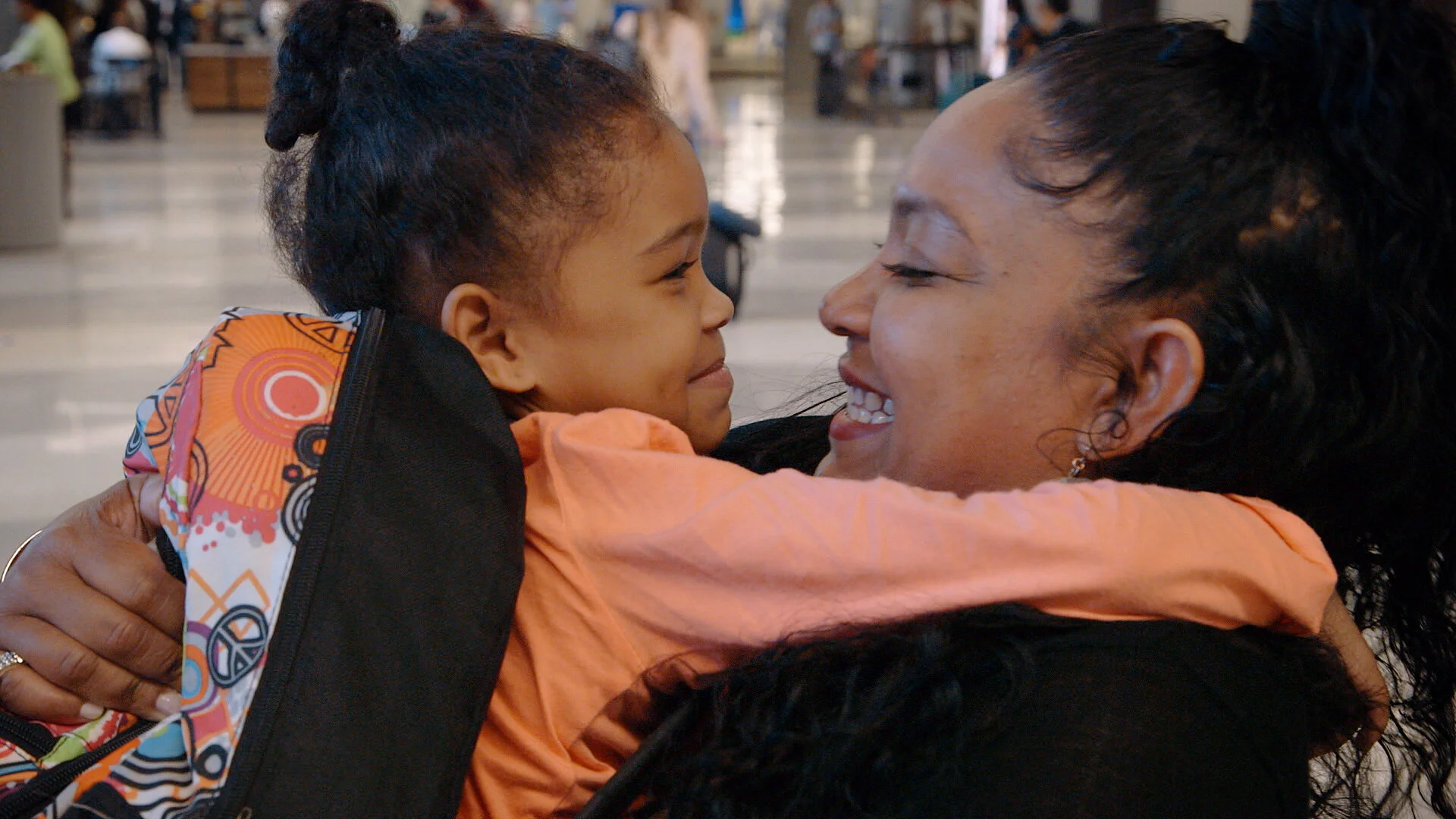
The Road Up - Alisa Cadette and her daughter

The Road Up - Alisa Cadette and her daughter

How have the script and film evolved over the course of their development?

JON: The process of making a documentary is never predictable. But to a certain extent, The Road Up evolved in a fairly conventional way: building trust with our subjects; reacting to events over time; and collaborating with our team to craft a compelling story. Much more unusual was how the response to the film evolved. While we believed all along that the film was urgently relevant, it was harder to convince people when unemployment was under 4% and the intersection of race, place, and poverty was, for many people, not front and center. But the confluence of covid-19 and the racial reckoning that followed the murder of George Floyd definitely changed that. So a lot of audiences are now approaching the film through a lens that may not have been there previously, which makes it not just powerful, but also really relevant.

What type of feedback have you received so far?

GREG: The response to the film so far has been even better than we could've expected, starting with its premiere last fall at the Chicago International Film Festival, where it won the documentary Audience Award. Two weeks ago, we got to watch the finished film for the first time with an audience in a theater, at the Sedona International Film Festival. During the Q&A, someone raised their hand and said, "I don't have a question. I just wanted to say that that was one of the ten best documentaries I've ever seen in my life!" When something like that happens, you start to think, "maybe we're on the right track."

Has the feedback surprised or challenged your point of view?

GREG: The Road Up is in some ways darker or more ambiguous than some of our other work, so it's been a bit surprising for me to see how often people describe it as "inspiring". In the end, we definitely wanted it to be hopeful—after all, as Jesse says in the film, "without hope, there's nothing"—as long as it felt earned, not manipulative or false. Judging from the feedback we've received, we seem to have hit the mark, leaving audiences with a sense that there is a road up for our subjects, but it's fragile, fraught, and precarious.

What are you looking to achieve by having your film more visible on www.wearemovingstories.com?

JON: While we've mostly been focused so far on connecting with impact-related audiences with The Road Up, www.wearemovingstories.com is an opportunity for the film to gain more visibility within the film community.

Who do you need to come on board (producers, sales agents, buyers, distributors, film festival directors, journalists) to amplify this film’s message?

JON: We encourage distributors to contact our sales agent, Annie Roney, at ro*co films; and we encourage journalists interested in the organization or the issues highlighted in the film to contact us!

What type of impact and/or reception would you like this film to have?

GREG: We're currently in the process of putting together an ambitious impact campaign for the film, starting with a discussion guide that can be read as both a basic "how-to" for hosting a screening and a primer on the causes and consequences of poverty. The goal of the campaign is to foster challenging conversations about the way systemic forces constrain opportunity in America, calling attention to the complex needs of the population Cara serves and sparking changes in corporate hiring practices, workforce development policies, and public attitudes nationwide. One thing we're now realizing is that this goal really resonates with corporate DEI & CSR efforts, so if those efforts are authentic, there may be some exciting opportunities to reach the decision-makers who determine just how inclusive our economy really is.

What’s a key question that will help spark a debate or begin a conversation about this film?

GREG: How do systemic forces constrain opportunity in America, and how do we address the complex needs of the population Cara serves in order to create a more inclusive economy?

The Road Up

The Road Up

What other projects are the key creatives developing or working on now?

JON: At the moment, we're focused on this film, as well as our continued work in the early childhood space with our partners in No Small Matter Media. But we've got a few ideas in the works, which we hope to get off the ground in the coming months!


Interview: July 2021


We Are Moving Stories embraces new voices in drama, documentary, animation, TV, web series, music video, women's films, LGBTQIA+, POC, First Nations, scifi, supernatural, horror, world cinema. If you have just made a film - we'd love to hear from you. Or if you know a filmmaker - can you recommend us?  More info: Carmela


The Road Up

Length

1:32:50

DIRECTORS

The co-founders of Chicago-based Siskel/Jacobs Productions, GREG JACOBS and JON SISKEL specialize in making entertaining, accessible films that tell compelling stories with integrity, complexity, emotion, and humor. Their work includes the acclaimed feature documentaries The Road Up, No Small Matter, and Louder Than a Bomb, as well as the Emmy Award-winning TV docs 102 Minutes That Changed America and Witness: Katrina.

PRODUCER

RACHEL PIKELNY is the founder of Nyla Pictures. Named to DOC NYC and Topic Studios’ inaugural “40 Under 40” list, Rachel has produced such acclaimed documentaries as The Road Up, Represent, No Small Matter, and The Trials of Muhammad Ali, and directed the award-winning short Grace. The co-chair of the Documentary Producers Alliance from 2016-20, she is dedicated to advancing producer agency in the documentary industry, and to strengthening the voices of underrepresented communities and storytellers.

Social media:

https://www.facebook.com/TheRoadUp

https://twitter.com/TheRoadUpFilm

https://www.instagram.com/theroadupfilm/

Hashtags:

#TheRoadUp, #TheRoadUpFilm, #TRUdocumentary

Looking for:

distributors, buyers

Where can I watch it?

Melbourne Documentary Film Festival/Melbourne, Australia - July 1-31


July 13, 2021 /Carmela Baranowska
Comment
Screen Shot 2021-07-08 at 11_28_38 PM.png

Focus on AFI Conservatory - U N T I T L E D

July 13, 2021 by Carmela Baranowska

A woman falls for another woman
who fears emotional intimacy.

Interview with Writer/Director Nicole Eckenroad


Congratulations! Why did you make your film?

I was lucky enough to be asked by the cinematographer, Bryce Holden, to partner on his graduate film at the AFI Conservatory. He wanted to make a short film about the rapid incline and decline of modern relationships. I had just experienced something like it, a relationship that had very significant impact on who the two of us have become and I wanted to capture the power of that.

Imagine I’m a member of the audience. Why should I watch this film?

This film is cathartic for anyone who has experienced love and/or heartbreak. It's beautiful and powerful, and manages to last in people's minds for days after watching it and it's only three minutes long.

How do personal and universal themes work in your film?

It's so personal, in fact it reveals deep secrets about my romantic experience. The sweeping feeling of love and the void left when you have to let that feeling go is something everyone experiences.

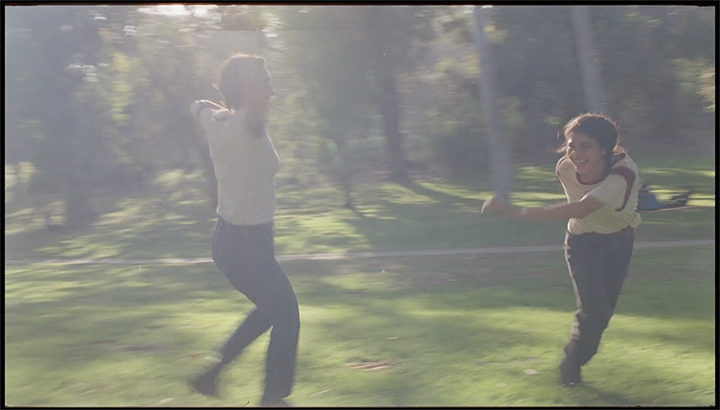
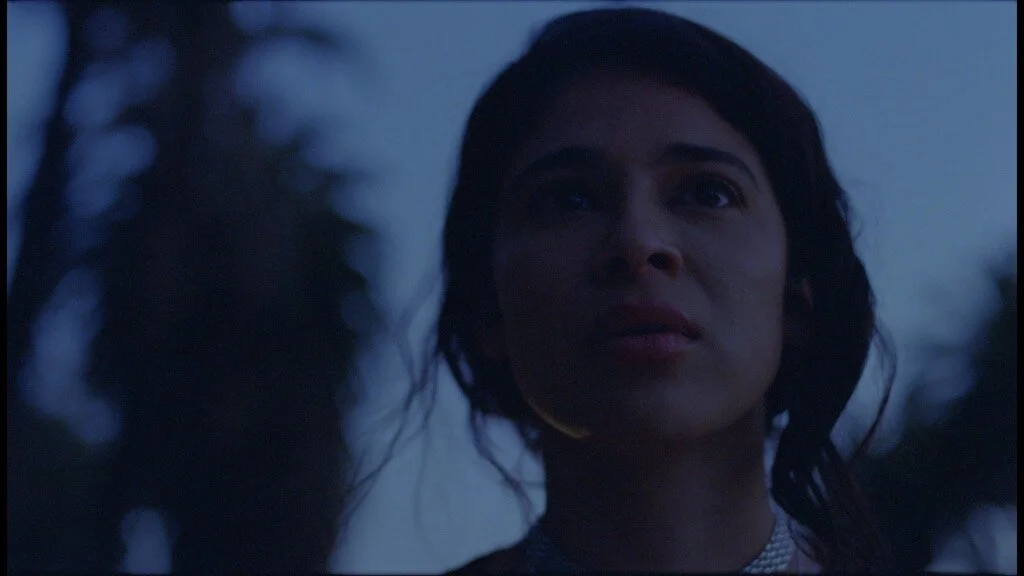
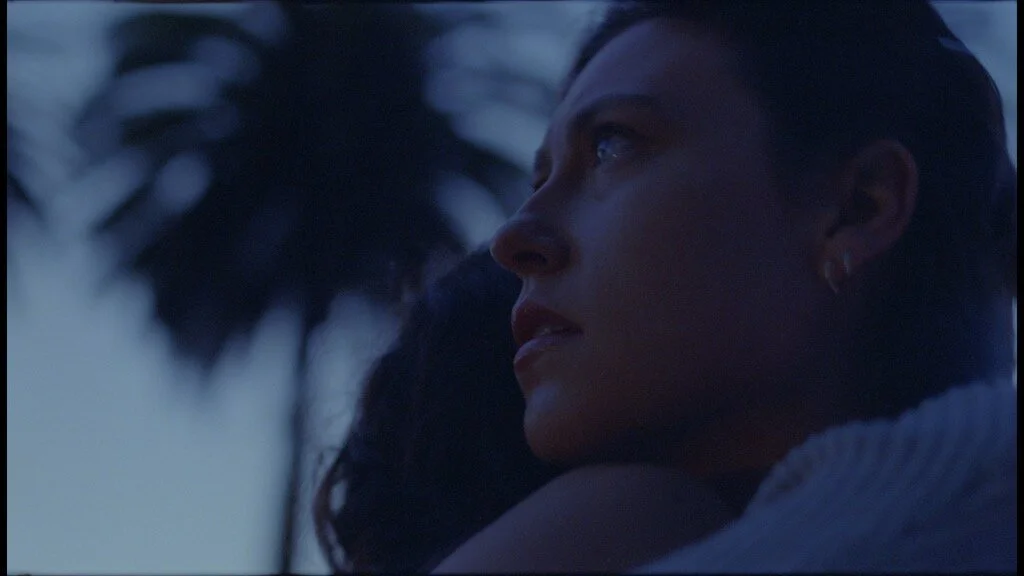
U N T I T L E D

U N T I T L E D

How have the script and film evolved over the course of their development?

The script and film have become so specific in their craft and beats. It started with a very general idea like most ideas, and went through a long period of emotional processing. In working with the lead actress, I got to work through some things I hadn't moved on from. I think that shows up in the film––the depth of emotional work that we all fed into it.

What type of feedback have you received so far?

A lot of people have said it's beautiful, heartbreaking and has stuck with them for a while.

Has the feedback surprised or challenged your point of view?

This may be the first time I've made a film where the feedback matches my own love for it.

U N T I T L E D

U N T I T L E D

What are you looking to achieve by having your film more visible on www.wearemovingstories.com?

I hope that it gains exposure as a queer story that isn't about the queerness––it's a film about grieving love. I want it to gain exposure, period. We're all really proud of the film and I want everyone to have their work seen and hopefully it gives us all more opportunities to create.

Who do you need to come on board (producers, sales agents, buyers, distributors, film festival directors, journalists) to amplify this film’s message?

We need buyers, distributors, film festival directors, journalists, social influencers––everyone who has the power to amplify this film.

What type of impact and/or reception would you like this film to have?

I want it to be appreciated for its ability to tell an epic love story in three minutes without any dialogue using 35mm film and practical lighting. I want people to see how gorgeous it is!

What’s a key question that will help spark a debate or begin a conversation about this film?

The relationship is like a cosmic clash––are these short-lived, big bang relationships actually more productive and positive for a human than a long steady one?

U N T I T L E D

U N T I T L E D

Would you like to add anything else?

I loved making this film so much. I loved working with Nikki Mejia, the lead actress. I got her to paint her first painting during our prep for the role, and the joy I witnessed her have throughout this project was such an honor. She was really brave in this, and very close to the story.

What other projects are the key creatives developing or working on now?

Nikki Mejia is also a director out of AFI and is in post production on her first feature "A Place in the Field." Bryce Holden, the cinematographer and EP of this film, is currently shooting his AFI thesis film with Julia Ponce Diaz. Heliya Alam just premiered a film she co-produced, called "The Birthday Cake." The second editor on the film, is assistant editor on HBO's "Euphoria." I am currently in preproduction on my second feature.

Interview: July 2021


We Are Moving Stories embraces new voices in drama, documentary, animation, TV, web series, music video, women's films, LGBTQIA+, POC, First Nations, scifi, supernatural, horror, world cinema. If you have just made a film - we'd love to hear from you. Or if you know a filmmaker - can you recommend us?  More info: Carmela


U N T I T L E D

Length:

3:10

Director

NICOLE ECKENROAD’s first feature, Leave Yourself Alone, is three-time award
winning. She directed one of seven original Twilight franchise shorts in partnership with WIF, Stephenie Meyer, Facebook and Lionsgate. She was the recipient of the Women In Film/Tichi-Wilkerson Endowed Scholarship and the AFI Scholarship Fund upon entering the AFI Conservatory as a writer/director. She is in preproduction on her second feature.

Producer

Heliya Alam

HELIYA ALAM received her film and TV studies degree from USC School of Cinematic Arts. She mastered multiple crafts such as producing, writing, editing and directing. On her journey, she wrote, produced and directed multiple short films and creatively carried them to festivals such as Cannes, Sundance and New Film Makers LA.

Some of her Producer credits on feature length films include, The Color Rose, The Birthday Cake and On Our Way. A Place in the Field will be her fifth feature this year. She has worked closely with companies such as Diablo Entertainment (production, post production - Sundance) and Route One Entertainment (Development) as well as big studios such as Fox Broadcasting Company and Warner Bros (writer/producer n the TV department.)

Cinematographer:

Bryce Holden

BRYCE HOLDEN received his BA from the University of Michigan with a major in Screen Arts and Cultures. In 2014, he moved to Los Angeles and began working in camera departments on a variety of projects as a camera operator, 1st AC and 2nd AC. While also working as a Prep Technician at a local camera rental house, Bryce has worked in over 20 different countries and shot for National Geographic Magazine.

Bryce’s first feature film as a Director of Photography, I TRAPPED THE DEVIL, was released in theaters earlier this year through IFC Midnight. Bryce is a Cinematography Fellow at the American Film Institute graduating in 2021.

Cast:

Nicole Mejia (Brooklyn), Cassidy Gyetvan (Alix)

Made in Association With

American Film Institute

Instagram

https://www.instagram.com/neckenroad/

More info:

nicoleeckenroad.com


July 13, 2021 /Carmela Baranowska
Comment
Still 4_Call For A Poetic City.png

MDFF 2021 - Call For A Poetic City

July 12, 2021 by Carmela Baranowska


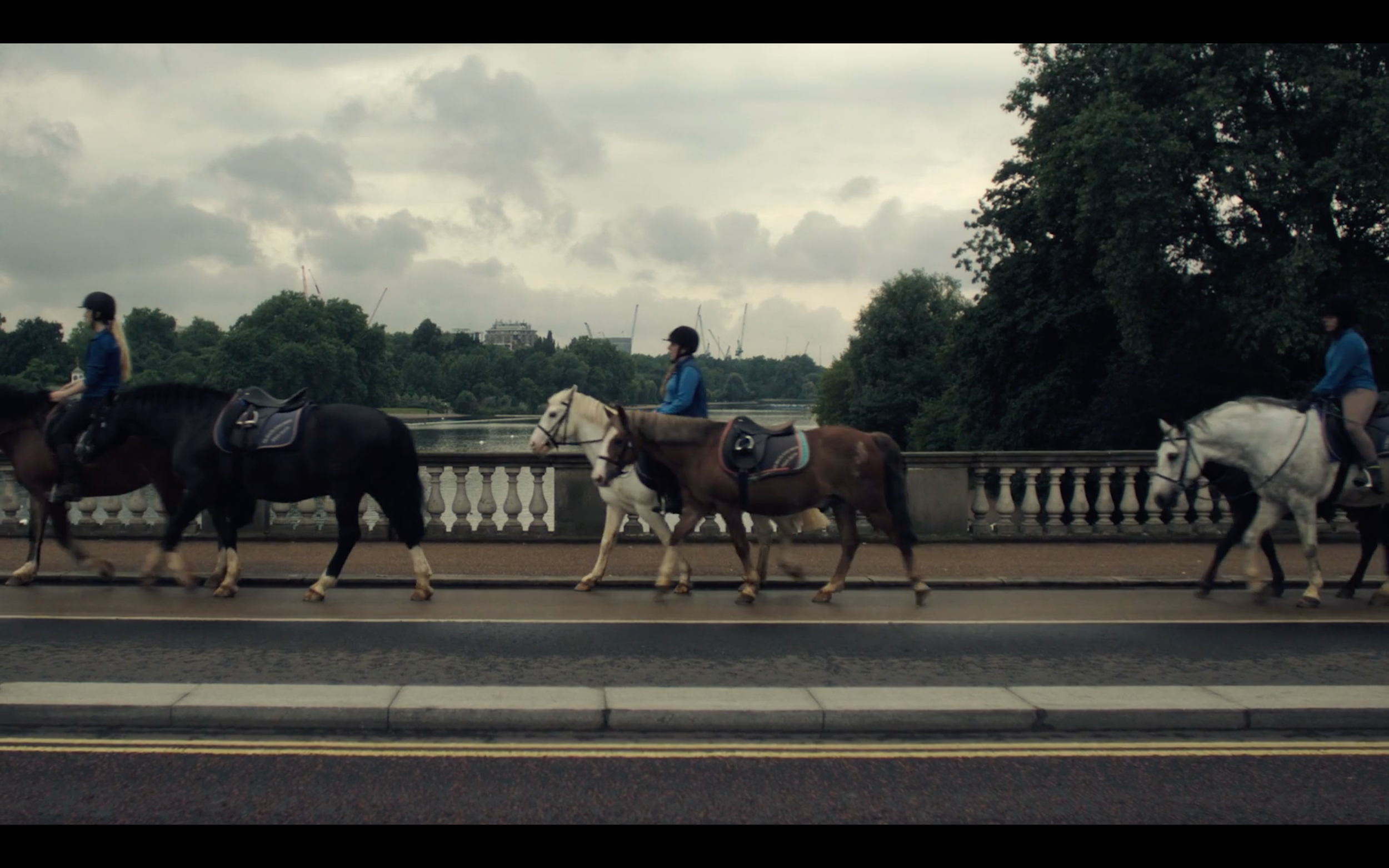
Poetic is Political. Horse-riding in a city center isn't a touristic endeavor, it undertakes a prominent role at the community level. Let us learn kindness.

Interview with Director/Producer Elisabeth Felson


Congratulations! Why did you make your film?

I live in Bayswater, London, nearby Ross Nye stables and always found sticking the surreal presence of horses in the heart of a city. As I got to know the stables, I discovered that far from being a touristic asset, they had a unique role at the local community level... I feel that it is a filmmaker's gift to show the true nature of things that may go unnoticed otherwise.

Imagine I’m a member of the audience. Why should I watch this film?

This film is a family program to enjoy by all ages and watch together. It is an optimistic take on our society and the importance of Nature in urban settings.

How do personal and universal themes work in your film?

Call For a Poetic City is the story of a family from Melbourne who emigrated to the UK and created Ross Nye Stables. The horses do clash with urban modern life, and all the same teach the Londoners kindness and mixity.

Call For A Poetic City

Call For A Poetic City

How have the script and film evolved over the course of their development?

There was a long editing searching for the language of the film, accentuating images instead of words and using Cinematography.

What type of feedback have you received so far?

The stables loved the film. Families like to watch the film altogether. People are surprised by the content. The film seems to have a poetic impact as hoped.

Has the feedback surprised or challenged your point of view?

Not really! As a creative work of art a film sets its own rules and language. Every film is different just like every book is different.

What are you looking to achieve by having your film more visible on www.wearemovingstories.com?

I am always happy to reach a wider audience.

Call For A Poetic City

Call For A Poetic City

Who do you need to come on board (producers, sales agents, buyers, distributors, film festival directors, journalists) to amplify this film’s message?

Distributors, buyers.

What type of impact and/or reception would you like this film to have?

I hope that people will realize how precious it is to protect Nature, and keep it in urban centers.

What’s a key question that will help spark a debate or begin a conversation about this film?

Shouldn't the Council defend and help these business who are so important to the local community?

Would you like to add anything else?

"In all things of Nature there is the marvelous"
Aristotle

Call For A Poetic City

Call For A Poetic City

What other projects are the key creatives developing or working on now?

I am shooting my second feature documentary in... two weeks now! Wish me luck!

Interview: July 2021


We Are Moving Stories embraces new voices in drama, documentary, animation, TV, web series, music video, women's films, LGBTQIA+, POC, First Nations, scifi, supernatural, horror, world cinema. If you have just made a film - we'd love to hear from you. Or if you know a filmmaker - can you recommend us?  More info: Carmela


Call For A Poetic City

Length:

1 hour

Director/Producer

Award-Winning Director / Producer, ELISABETH FELSON is currently in Pre-production of her second feature Documentary and is in the Sundance Collab Creative Producer Mentorship Course. She is the recipient of several awards & nominations in Direction and Production and is an alumni of Cambridge University (History of Political Ideas), and the Sorbonne (Arts, Honors).

Looking for:

buyers, distributors

Instagram:

https://www.instagram.com/steppenwolvesfilms/

More info:

www.steppenwolvesfilms.com


July 12, 2021 /Carmela Baranowska
Comment

MDFF 2021 - With Flying Colours

July 12, 2021 by Carmela Baranowska

The colourful true story of Australia's first female helicopter pilot, Rosemary Arnold, who shook the male dominated aviation industry and inspired a new generation of female pilots by using fashion to combat sexism.

Interview with Writer/Director/Producer Christina Hogarth


Congratulations! Why did you make your film?

Firstly, because Rosemary is such an incredible character! She is not only Australia's first female helicopter pilot, but a fashion icon and a trailblazer. Rosemary inspired generations of female pilots through nurturing and inspiring them.

I made this film to preserve the history of women in aviation, to encourage more women into flying, and to get Rosemary the recognition that she deserves.

Imagine I’m a member of the audience. Why should I watch this film?

To learn about the pioneering aviatrixes who paved the way for women in aviation today, to see that age is just a number, and to understand that you can overcome adversity through being the best version of yourself.

How do personal and universal themes work in your film?

Overcoming adversity and turning perceived weaknesses into strengths:
Rosemary overcame the barriers to becoming a pilot by using her skills as a dress maker to pay for her license and her sense of style to stand out as a female in a male dominated industry.

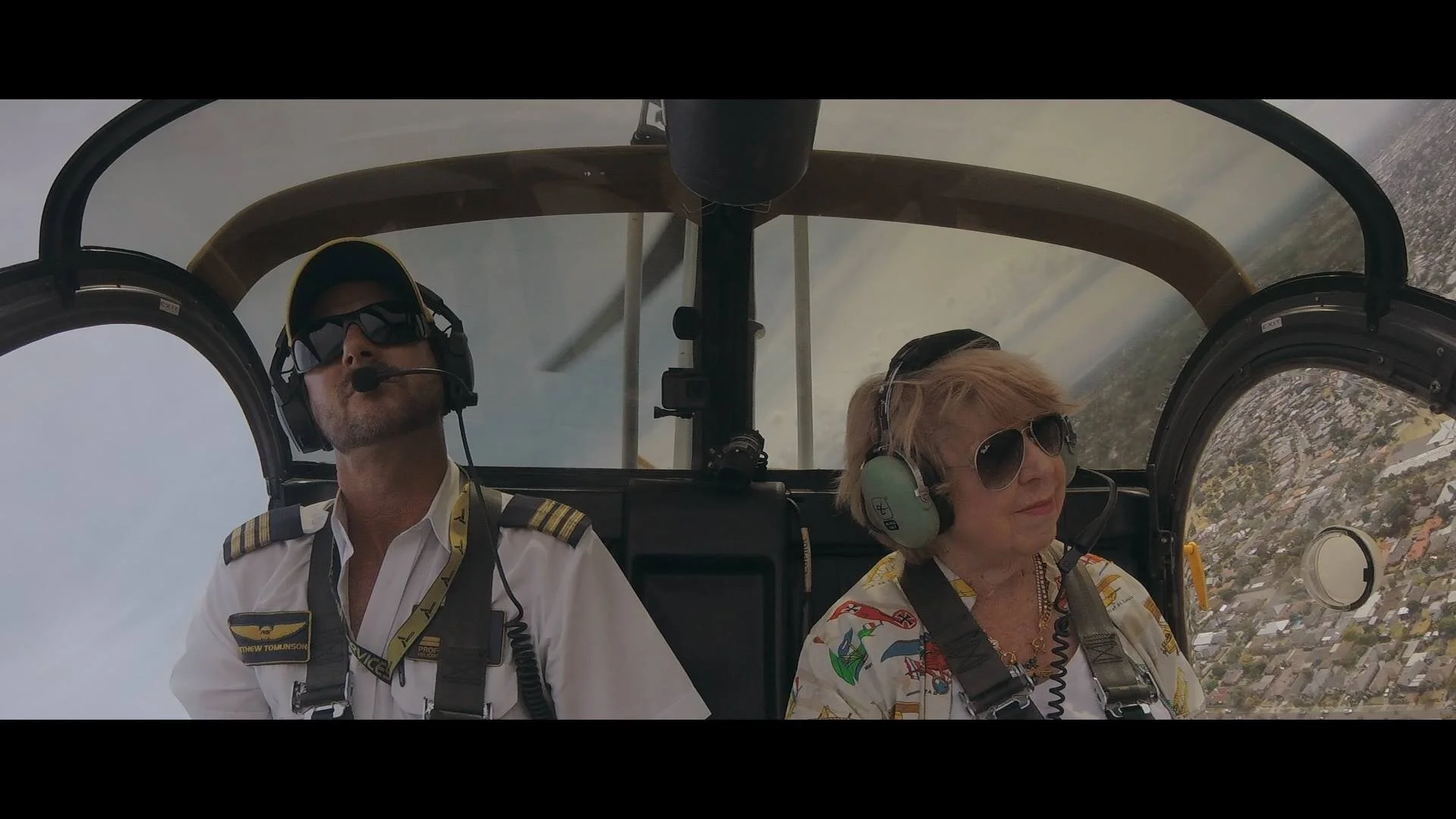
With Flying Colours - Matt & Rosemary: Pilot Matt Tomlinson and Rosemary Arnold flying the Hughes 300 at Moorabbin Airport.

With Flying Colours - Matt & Rosemary: Pilot Matt Tomlinson and Rosemary Arnold flying the Hughes 300 at Moorabbin Airport.

How have the script and film evolved over the course of their development?

New opportunities arose throughout filming that added different layers to the film ie. Rosemary's motivational speech at the Moorabbin Air League and conducting her final wedding.

What type of feedback have you received so far?

Audience members have said that Rosemary has inspired them, and that they would like to try flying.

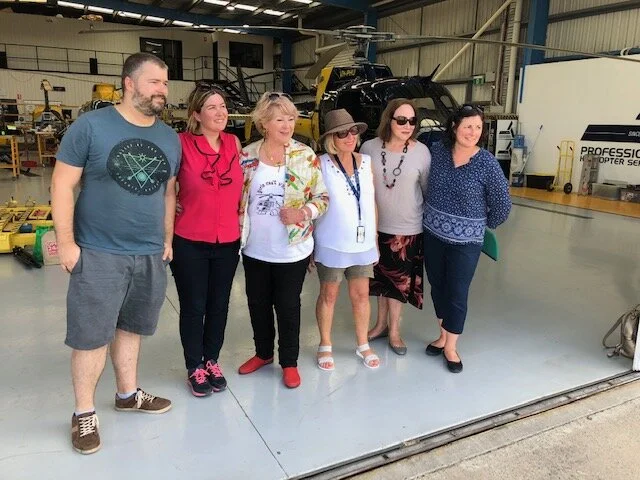
With Flying Colours - Rosemary With Crew: from left to right: DP Johanness Gross, Director Christina Hogarth, Rosemary Arnold, pilots Jenny Gust & Suzanne Litchfield and First AD Melanie Jacobsen

With Flying Colours - Rosemary With Crew: from left to right: DP Johanness Gross, Director Christina Hogarth, Rosemary Arnold, pilots Jenny Gust & Suzanne Litchfield and First AD Melanie Jacobsen

Has the feedback surprised or challenged your point of view?

It has made us feel that we have done something right because it is achieving what we set out to do.

What are you looking to achieve by having your film more visible on www.wearemovingstories.com?

Just to get the story out there and change people's lives for the better

Who do you need to come on board (producers, sales agents, buyers, distributors, film festival directors, journalists) to amplify this film’s message?

An Aussie film distributor would be good.

What type of impact and/or reception would you like this film to have?

To bring awareness and recognition to the trailblazing aviatrixes, and to encourage more women into aviation

What’s a key question that will help spark a debate or begin a conversation about this film?

What is the aviation industry like now for women?

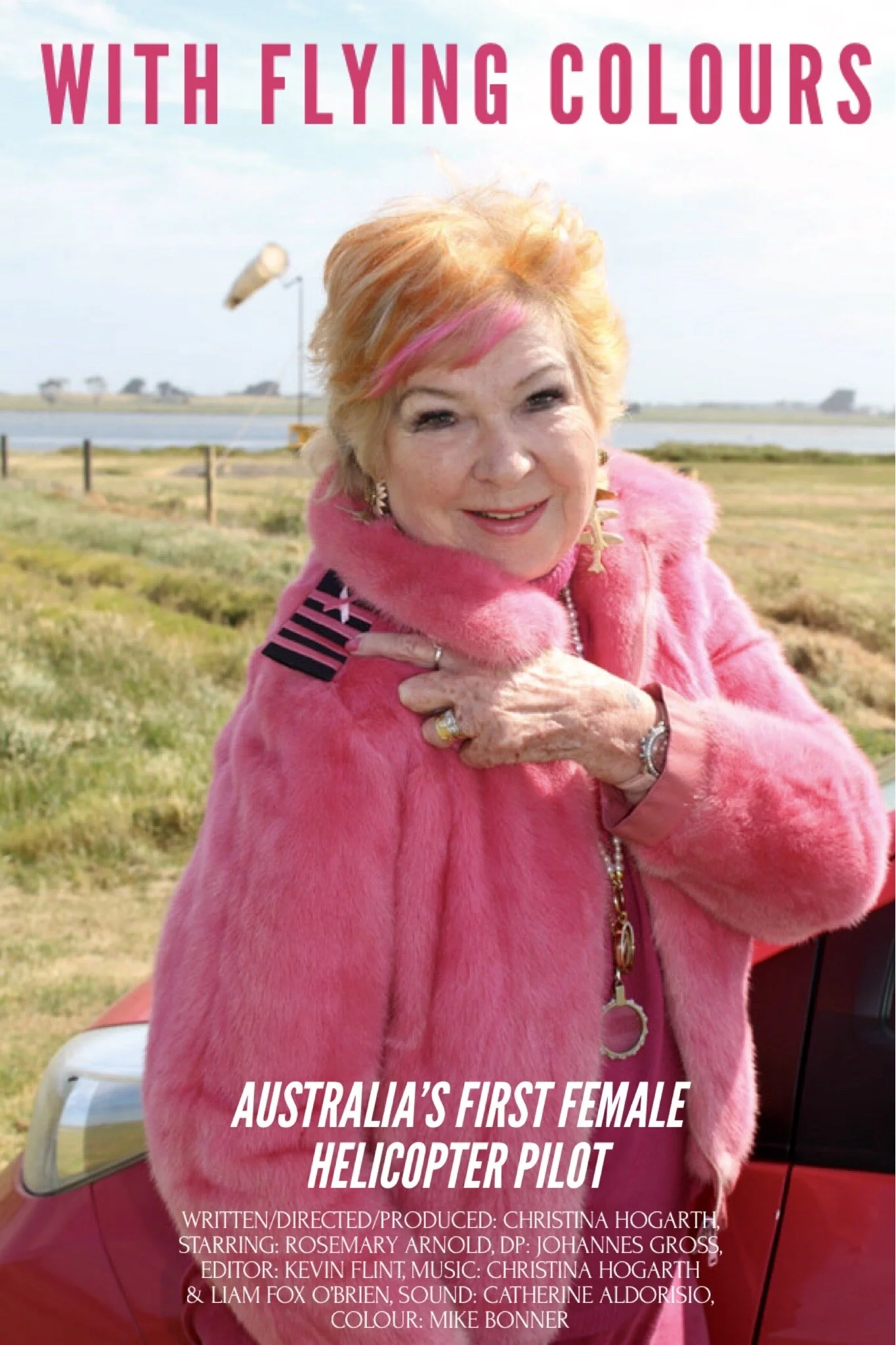
With Flying Colours

With Flying Colours

Would you like to add anything else?

I promote the film using the With Flying Colours Facebook page and my personal FB page. As I co-composed the film score on my Ukulele, I use my IG music page @chrissy_ukulele to promote and tag festivals on Instagram.

What other projects are the key creatives developing or working on now?

Promoting the film to the festivals and taking a bit of a break

Interview: July 2021


We Are Moving Stories embraces new voices in drama, documentary, animation, TV, web series, music video, women's films, LGBTQIA+, POC, First Nations, scifi, supernatural, horror, world cinema. If you have just made a film - we'd love to hear from you. Or if you know a filmmaker - can you recommend us?  More info: Carmela


With Flying Colours

Length:
53 minutes

Writer/Director/Producer

CHRISTINA HOGARTH is a commercial helicopter pilot and award winning filmmaker from Melbourne, Australia who currently resides in Los Angeles. Her films have played at festivals around the globe.

With Flying Colours is Christina's latest project that she wrote/directed/produced and scored on Ukulele (another creative passion) with fellow Australian composer, Liam Fox O'Brien.

This documentary was filmed in Australia and completed post production in Los Angeles. Christina hopes that the film will inspire more women to enter the aviation industry.

Facebook:

https://www.facebook.com/With-Flying-Colours-104612751764405/

Hashtags used:
#womeninaviation #withflyingcolours #femalepilots #aviatrix #helicpoterpilot #helicopters


Where can I watch it now?
Melbourne Documentary Film Festival online July 1-31st

https://watch.eventive.org/mdff/play/60c17f92f69a8c0030284bfb


July 12, 2021 /Carmela Baranowska
Comment

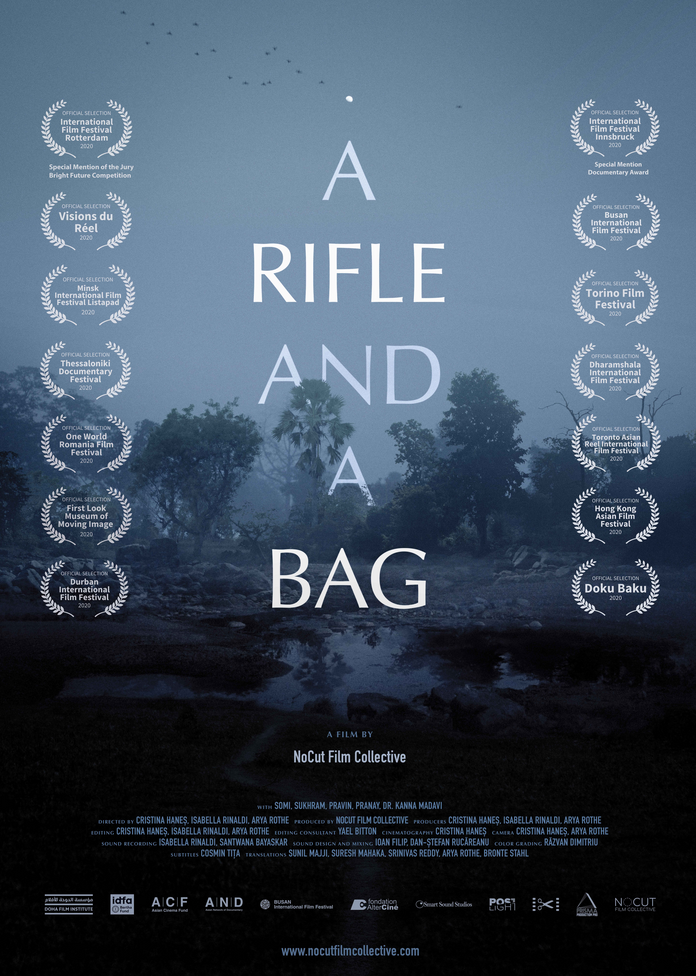
MDFF 2021 - A Rifle and a Bag

July 10, 2021 by Carmela Baranowska

A young Indian couple of surrendered communist rebels (Naxalites) is fighting for their children's future.

Interview with NoCut Film Collective (Cristina Hanes - Romania, Isabella Rinaldi - Italy, Arya Rothe - India)

Watch A Rifle and a Bag on dafilms

Congratulations! Why did you make your film?

We (Cristina Hanes, Romania, Isabella Rinaldi, Italy and Arya Rothe, India) started NoCut Film Collective in 2016 because we wanted to direct independent creative documentary films.

After studying together at the DocNomads Master Course in Documentary Directing, we started the research for our first feature length film in India. We learnt about the existence of the surrendered Naxalite settlements. The Naxalites are a communist guerrilla group that has been fighting since the 60’s for the rights of the indigenous communities of India.

We met and spoke to several surrendered Naxalites from that particular settlement, but it was only after we met Somi that we felt there was a story to tell. It was not only her background that struck us, but also Somi’s strength and straightforwardness. Somi and her husband, Sukhram met and fell in love inside the Naxalite commando unit from which they surrendered together. Their story as a couple and their solid relationship were also very gripping for us.

We understood when we met her that she was struggling to enroll her son Dadu in a school and she was facing many obstacles because of her past as a Maoist guerrilla rebel. This was to us the starting point for telling her and her family’s story.

Imagine I’m a member of the audience. Why should I watch this film?

We recommend you our film firstly to get to know Somi, a strong and inspiring female character but also for a window into a very relevant political issue that is very controversial in India and across Asia, but very little known in the rest of the world.

How do personal and universal themes work in your film?

Since the beginning we wanted to tackle a universal theme through a personal story. However incomplete or subjective a point of view of an individual can be, we knew that Somi's views would allow us to tackle universal issues that lie outside of India’s Maoist guerrilla. Our aim with the film was to discover the complex texture of moral, ideological and political engagement.

A Rifle and a Bag

A Rifle and a Bag

How have the script and film evolved over the course of their development?

We imagined the film within our script quite close to how it turned out to be in the end. As we are working with reality, some aspects we could plan but for others we just had to anticipate or just be present and film them, as they were happening.

Some of the scenes in the film are achieved in collaboration with the characters. The scenes that were triggered by us were always drawn from things we were told or we witnessed, that we would later on discuss with the characters in order to decide together the right moment to film them. Other scenes were shot completely spontaneous and “observational”, so in the film you can find a mix of these two approaches.

What type of feedback have you received so far?

Although we premiered the film in the pre-pandemic world in January 2020 at the Rotterdam International Film Festival, the film's journey had to be rerouted almost entirely online following this very first encounter with the audience. The feedback we managed to receive were in the form of endearing messages on social media or from film reviews. One very dear to us remark about one of the scenes in the film comes from Victor Morozov, a young Romanian film critic: "Yet it’s possible that this rediscovery of an utopia by the mother might be favoured exactly because she is in the experience of being in front of the camera – because the film manages to camouflage, if not invert, the power dynamics of a white foreigner filming an indigenous person. The impression that’s left is that, while going against the current, Somi – much more energetic and at ease than her husband – takes the technology into her own hands and uses it exactly to gain wings of her own, to take her struggle to new places."

Has the feedback surprised or challenged your point of view?

In general the feedback was strongly oriented towards the main character of the film, Somi. Although the political context of the film is little known outside India and Somi's background as a guerrilla fighter is something far from the reality of most of us, many felt that Somi is a relatable character and they could deeply grasp her struggle, both personal and for her family.

What are you looking to achieve by having your film more visible on www.wearemovingstories.com?

We hope for the film to be seen in different parts of the world.

Who do you need to come on board (producers, sales agents, buyers, distributors, film festival directors, journalists) to amplify this film’s message?

For the film to amplify its cause, buyers, distributors and film festival directors are needed to come on board.

What type of impact and/or reception would you like this film to have?

We would like the film to problematise an issue that is very polarised in the mainstream media and to amplify Somi's voice.

A Rifle and a Bag

A Rifle and a Bag

What’s a key question that will help spark a debate or begin a conversation about this film?

Where is the line between sacrificing for your family and sacrificing your family? What is the price to pay for trying to build a utopia?

What other projects are the key creatives developing or working on now?

We are collaborating with various filmmakers from across the world. At the moment, NoCut Film Collective is producing and co-producing creative documentaries in India, Nepal and Romania. On our website https://www.nocutfilmcollective.com/ you can find more about these ongoing projects!

Interview: July 2021


We Are Moving Stories embraces new voices in drama, documentary, animation, TV, web series, music video, women's films, LGBTQIA+, POC, First Nations, scifi, supernatural, horror, world cinema. If you have just made a film - we'd love to hear from you. Or if you know a filmmaker - can you recommend us?  More info: Carmela


A Rifle and a Bag

Length: 1 hour and 29 minutes

Writer/Director/Producer

NoCut Film Collective was co-founded in 2016 by three filmmakers Cristina Haneș (Romania), Isabella Rinaldi (Italy) and Arya Rothe (India). The collective directs and produces author-driven documentaries, envisioning filmmaking as collaborative and transcultural.

Looking for:

Distributors, Film Festival Directors, Buyers

Facebook:

https://www.facebook.com/nocutfilmcollective

Instagram:

https://www.instagram.com/nocutfilmcollective/

Hashtags used:

#arifleandabag

More info:

https://www.instagram.com/nocutfilmcollective/

Where can I watch it next?

2021 Beirut International Women Film Festival/ Lebanon - July, 19-23; 2021 Indian Film Festival Stuttgart/ Germany - July, 23; 2021 First Look Museum of Moving Image (MOMI)/ New York City, U.S. - August, 2


July 10, 2021 /Carmela Baranowska
Comment

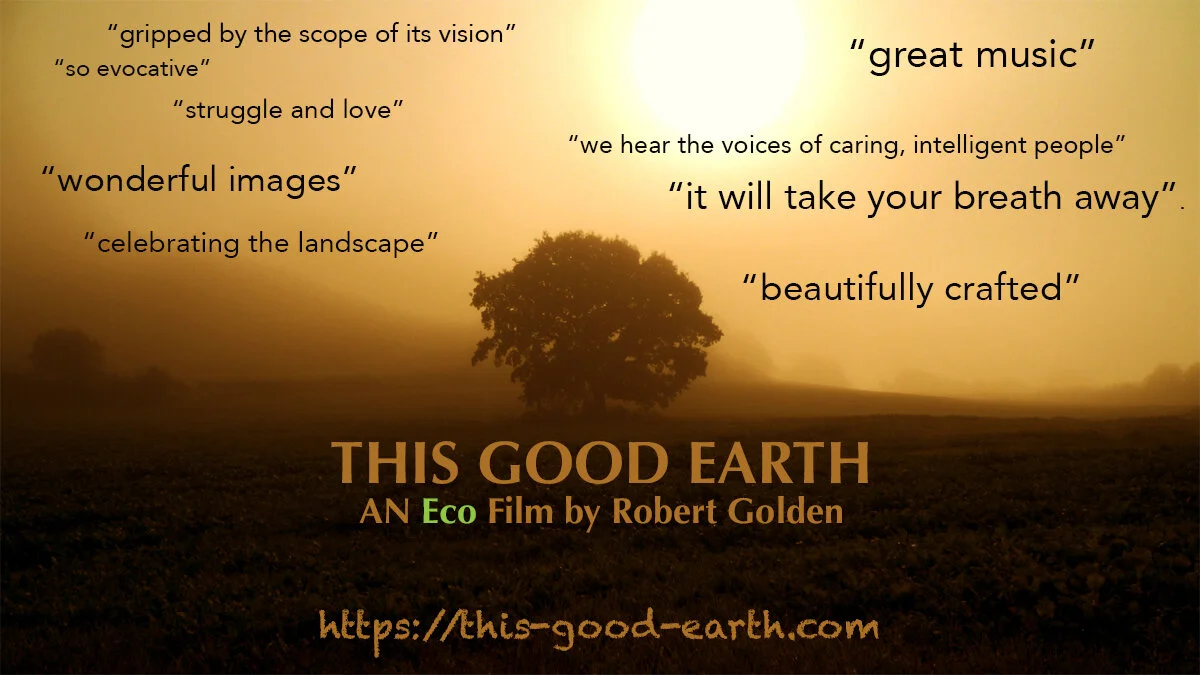
MDFF 2021 - This Good Earth

July 10, 2021 by Carmela Baranowska

With increasing damage to eco systems, destruction from global warming, growing mental and physical damage to millions of people, THIS GOOD EARTH offers answers to how change can happen.

Interview with Writer/Director Robert Golden


Congratulations! Why did you make your film?

This film is about the reality of global warming, impoverished diets and rising hunger, disease and deaths, and also about loving the land and other living things and conversely about insisting that the only way to maintain one’s dignity and humanity is to resist, but also to turn away from the politicians and CEO’s impervious and brutal order, for us to become a new and better people whilst at the same time pointing our fingers at those who would destroy our grandchildren’s lives.

Imagine I’m a member of the audience. Why should I watch this film?

Unlike many films, THIS GOOD EARTH seeks to create a unified whole understanding out of the many elements of the long food chain from soil to plate. For instance, It helps people to understand the relationship between soil degradation and the climate crisis, between eating beef and the huge waste of energy and land occurring everyday, between corporate greed and ill health, and many other problems that are leading our earth and our species towards flaming Holocausts, flooding, illness and death. It seeks to awaken people to those politicians, corporate actors and others who are condemning their children and grandchildren to a hellish world of migrations, poverty and wars, as it encourages people to fall or re-fall in love with this beautiful earth.

How do personal and universal themes work in your film?

The in-depth interviews reveal both the speaker's knowledge and her/his emotional commitment to their work. At the same time the whole structure of the film is based in the particular conditions of Dorset as a representation of many national and international problems playing their role in our universal existential crisis

How have the script and film evolved over the course of their development?

All of my films begin with a set of notions, ideas, points-of-view to be used as a basis for stating research and choosing subject matter to represent the themes. By encountering the reality of the world I enter and through listening closely to what people are and often aren't saying in interviews, I begin to recognise that my high concept needs to be altered. In THIS GOOD EARTH, the original theme altered twice, based on me coming to understand emotionally and intellectually that what I was uncovering was more important than the themes and structures I began with.

This Good Earth

This Good Earth

What type of feedback have you received so far?

Many people have responded by saying three things: that the film is very beautiful, that it is very clear and that it is revealing of something so central to our existence and that everybody should see it and especially young people, as it is about their futures.

Has the feedback surprised or challenged your point of view?

The feedback has really surprised me. Although I intended the film to be visually beautifully and emotionally strong, to find that it worked so well is deeply satisfying. The beauty was intended to embrace the audience while the hard facts were meant to stir people up...this combination has seemingly worked.

What are you looking to achieve by having your film more visible on www.wearemovingstories.com?

Anything that can get the message of the film to people will be a great help.

Who do you need to come on board (producers, sales agents, buyers, distributors, film festival directors, journalists) to amplify this film’s message?

We need a sales agent or a distributor who gets the meaning and importance of the film, film festival directors and journalists who may help to connect with potential audiences.

What type of impact and/or reception would you like this film to have?

The film is causing discussions, helping people to formulate and ask tough questions, perhaps waking some people up to the impending crisis; I want more of that.

This Good Earth

This Good Earth

What’s a key question that will help spark a debate or begin a conversation about this film?

The people interviewed in the film reveal a depth of knowledge about what changes are vital; the structure of the film reveals the interconnectivity of the problems; the consequences uncomfortably (for some) point a finger at those people and corporations standing in the way of immediate change and call for tough legal consequences to be enacted against them. A debate seems to exist over doing so. That is the central point of tension in the film, all the rest are the revelations which frame this tension.

Would you like to add anything else?

I am surprised and in some cases disappointed with some editorial writers and organisations who should be natural allies of the film, have chosen to ignore it.

What other projects are the key creatives developing or working on now?

I have two film projects in development. One is to support spreading the word about a new Rights Respecting Charter and the other is about an attempt to document the private thoughts and emotions of different groups of people to reveal their most profound attitudes at this transitional moment in European history. I also am finishing a book about creative motivation applied to making photographs.

This Good Earth

This Good Earth


Interview: July 2021


We Are Moving Stories embraces new voices in drama, documentary, animation, TV, web series, music video, women's films, LGBTQIA+, POC, First Nations, scifi, supernatural, horror, world cinema. If you have just made a film - we'd love to hear from you. Or if you know a filmmaker - can you recommend us?  More info: Carmela


This Good Earth

Length:

1 hour 30 minutes

Writer

ROBERT GOLDEN has written over 40 film scripts for documentaries and feature films as well as 15 books, 1 novel, an epic poem and other poetry and 3 plays.

Director

ROBERT GOLDEN began his career as a photojournalist photographing many stores for magazines and newspapers. Afterwards he directed and was the DOP on over 900 commercials for TV, over 40 documentaries and 2 award fiction films.

Producer

ROBERT GOLDEN has produced or co-produced several feature films and over 40 documentaries.

TINA ELLEN LEE has co-produced with Robert Golden over 40 documentaries as well as numerous theatre productions.

Looking for:

Journalists, Buyers, Distributors

Where can I watch it now?
https://this-good-earth.com

July 10, 2021 /Carmela Baranowska
2 Comments

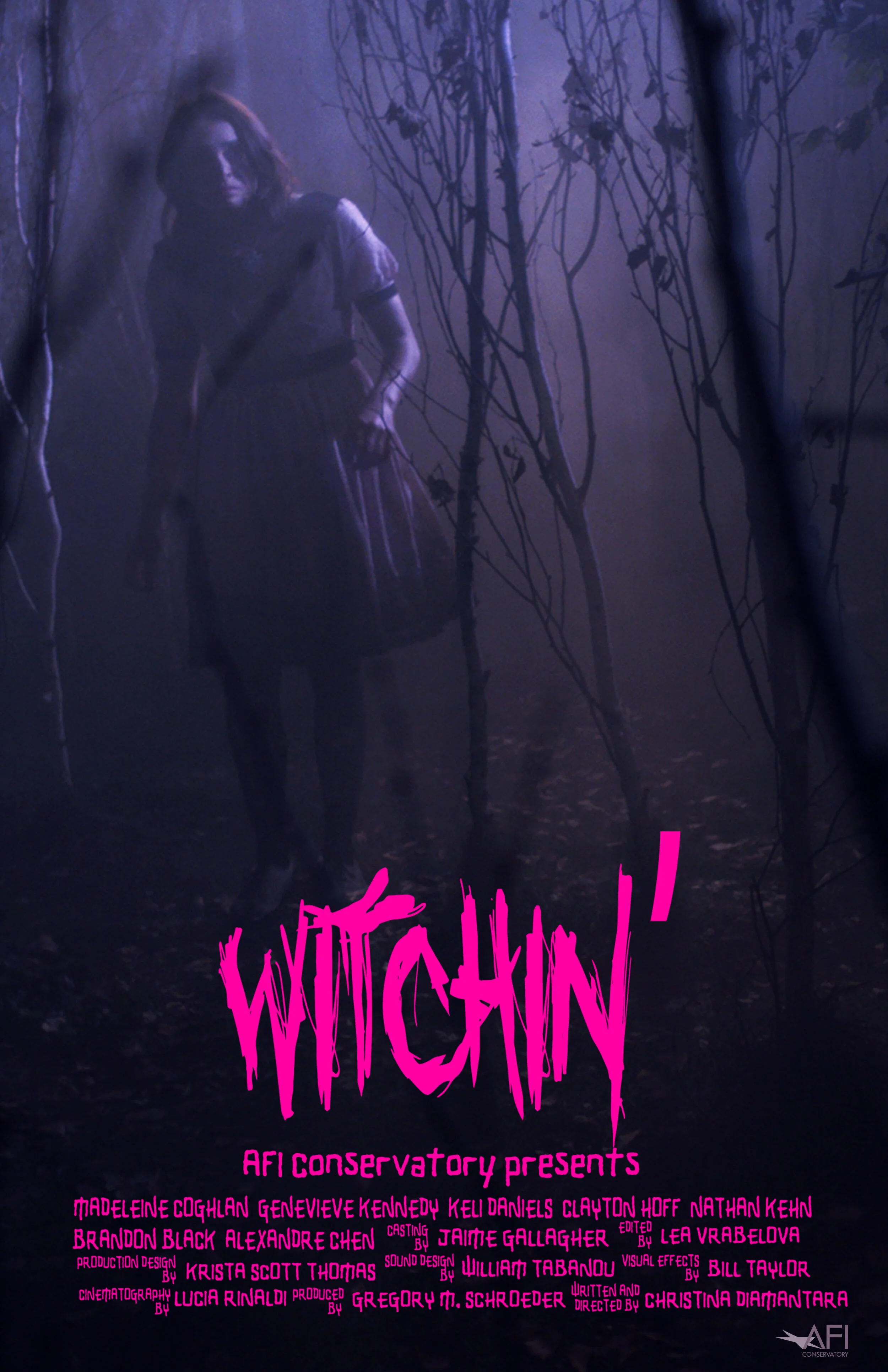
Focus on AFI Conservatory - Witchin'

July 10, 2021 by Carmela Baranowska

A young naive witch will face the dark side of ambition when she visits the world of humans in search of the powerful and notorious Big Dick Energy.

Interview with Writer/Director Christina Diamantara

Congratulations! Why did you make your film?

Witchin' was completed as my thesis project requirement in order to graduate from my Masters program at the American Film Institute. But through the course of development, the film became more and more of a personal expression necessity.

Imagine I’m a member of the audience. Why should I watch this film?

Because it's a colourful, funny and exuberant satire of modern society through the lens of the fantasy genre.

How do personal and universal themes work in your film?

On the one hand, the protagonist's journey depicts a naive girl going after her goals and ambitions and learning that there's a price to pay for success. I have personally had such an experience which is probably like any other coming of age story. However I feel that this personal story is also a metaphor for my whole generation who grew up in the reigns of a strong capitalism (reinforced through fairy-tales) only to witness its cracks and darker side with the financial and social crisis we experienced as we grew older.

At the same time, this is a woman's story and again my personal experience and at the same time a universal observation about women who go after their professional goals but are ultimately forced to interact with the previously sole power occupants, men.

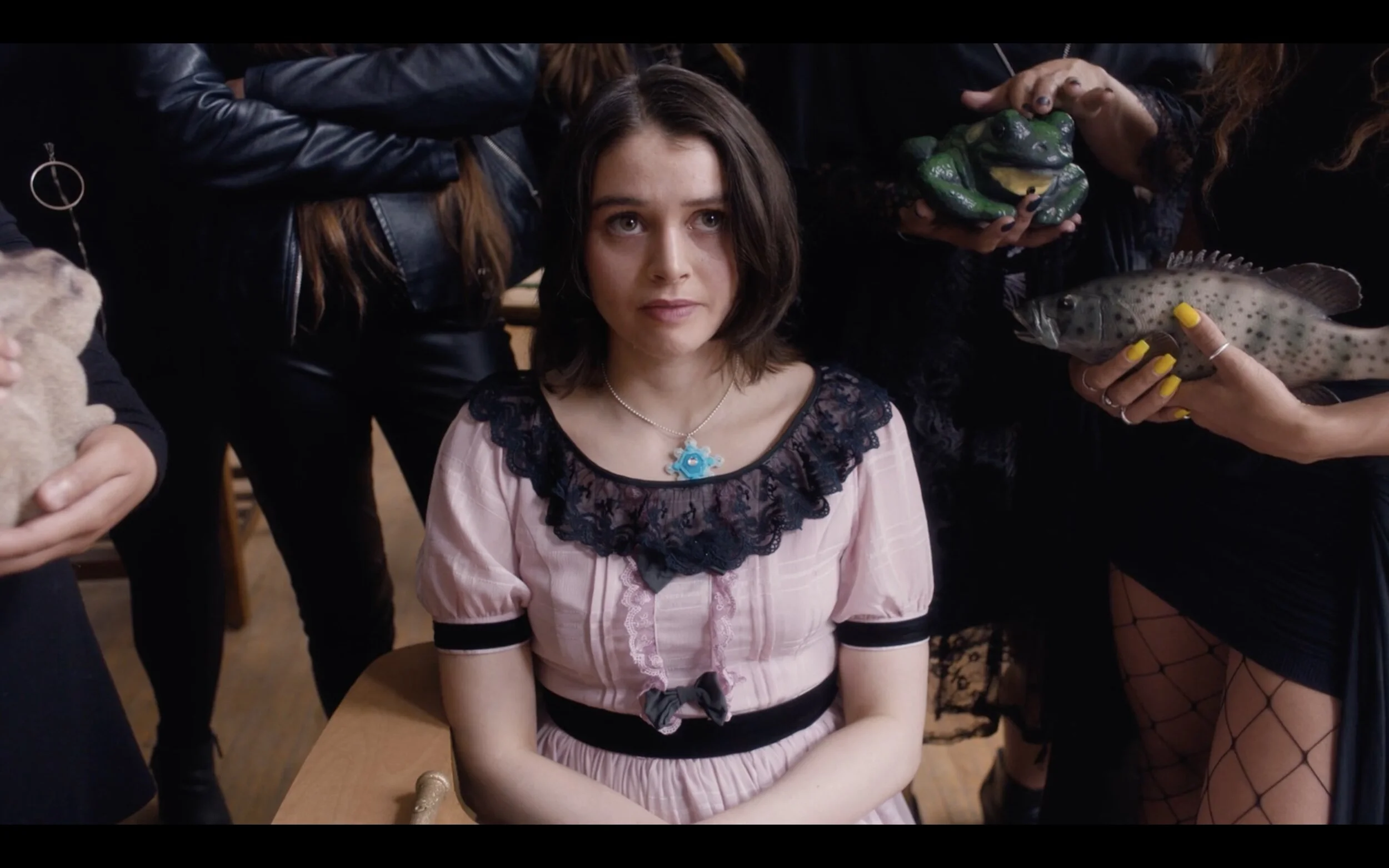
Witchin'

Witchin'

How have the script and film evolved over the course of their development?

At first, our focus was female friendships and competitiveness, so the role of Linda, Donnie's faux friend was much bigger. As we talked more and more and provided more depth for our characters, we realised that person one who learns the most at the end of the story is Donnie, and that's when we gave all our focus to her individual journey.

What type of feedback have you received so far?

Such lovely words and feedback! We always knew that due to the nature of some provoking sexual themes and the use of curse words in the film, we were in a way narrowing down our intended viewers. But when the film meets its audience, there seems to be a great connection and appreciation for the story, the performances and the overall construction.

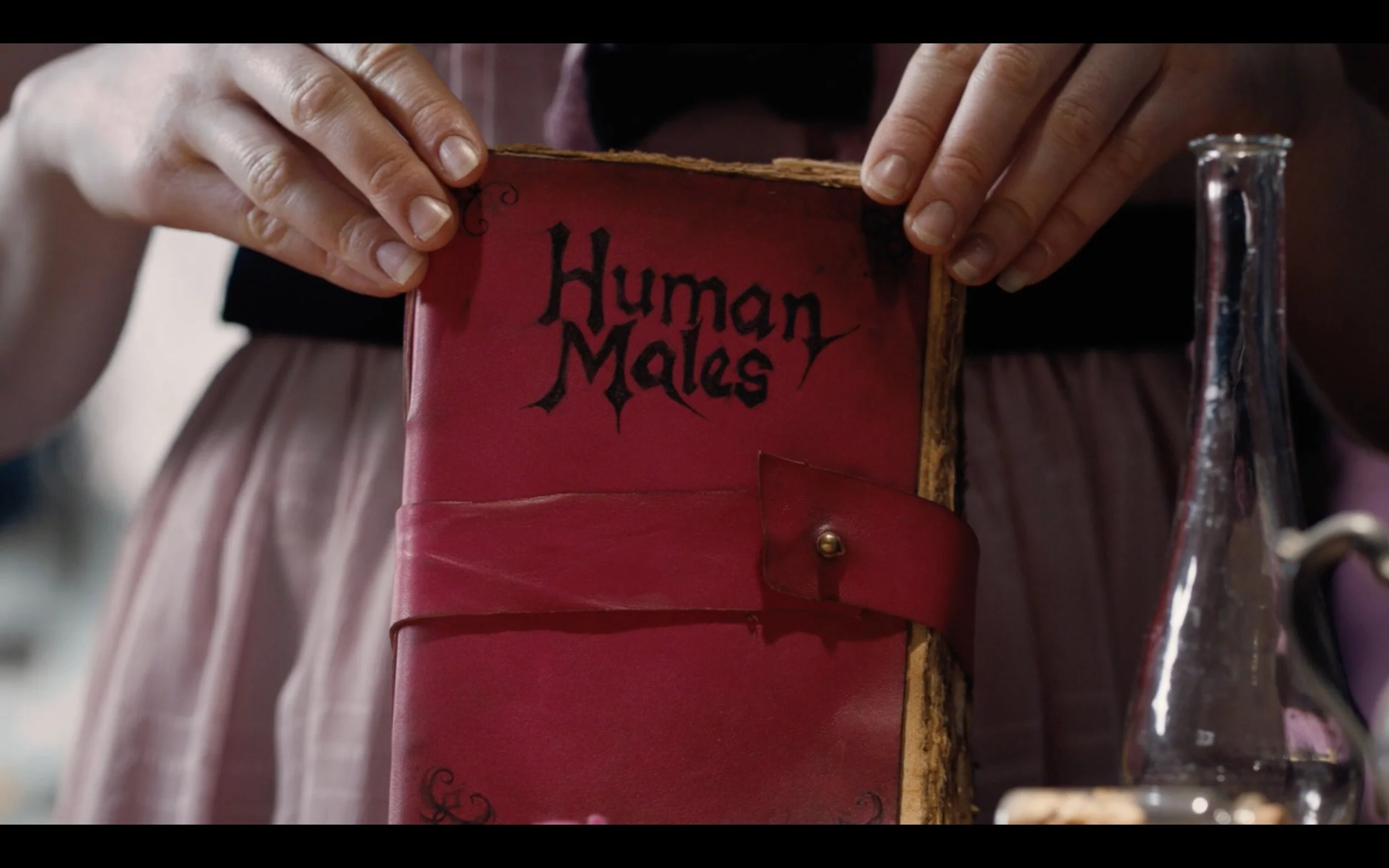
Witchin'

Witchin'

Has the feedback surprised or challenged your point of view?

Unfortunately not very much, even though this would be very welcomed as I consider the exchange of point of views one of the biggest pleasures of filmmaking. I attribute this more than anything else to the fact that our festival run was heavily affected by the pandemic, and therefore we didn't have the chance to attend festivals and speak directly with the people who watched the film.

What are you looking to achieve by having your film more visible on www.wearemovingstories.com?

To continue growing our online presence and to reach more audiences.

Who do you need to come on board (producers, sales agents, buyers, distributors, film festival directors, journalists) to amplify this film’s message?

Right now we're still submitting to film festivals and soon we will start looking into online platforms that could potentially host the film.

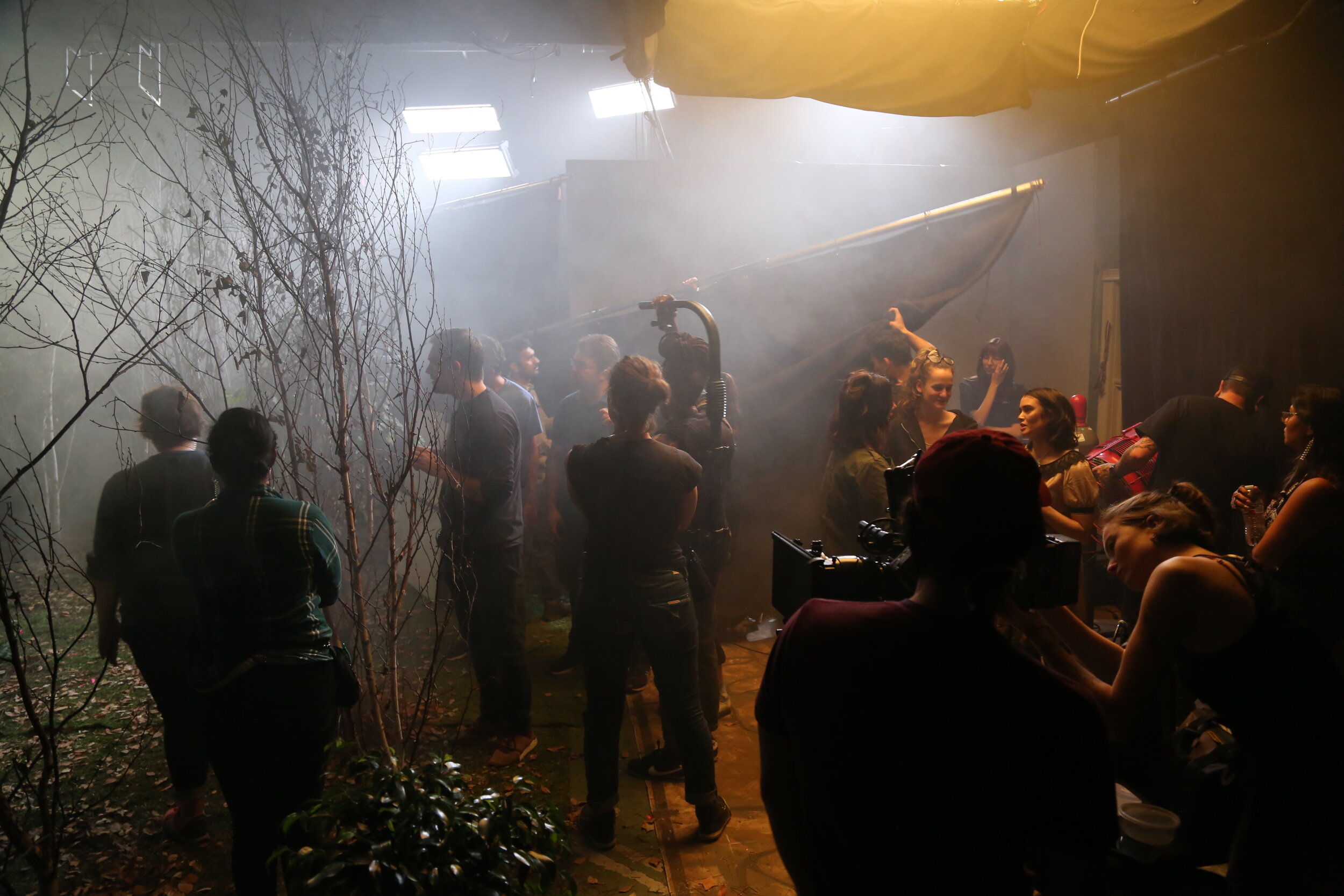
BTS - Witchin'

BTS - Witchin'

What type of impact and/or reception would you like this film to have?

I would like audiences to be entertained while also engaged in the morality roller coaster that the film takes them through.

What’s a key question that will help spark a debate or begin a conversation about this film?

Do we need to be "bad" to be successful?

Witchin'

Witchin'

Would you like to add anything else?

Thank you for reading and watching!

What other projects are the key creatives developing or working on now?

I'm developing the TV series version of Witchin', a low budget feature (Red Buffalo) about young women and their relationship with sugar dating and an animated feature (Gorgona) about a woman who is transformed into a kelp plant, and then trapped in the depths of a polluted ocean.

I'm also working on multiple dubs and some commercials in various stages of production.

Interview: July 2021


We Are Moving Stories embraces new voices in drama, documentary, animation, TV, web series, music video, women's films, LGBTQIA+, POC, First Nations, scifi, supernatural, horror, world cinema. If you have just made a film - we'd love to hear from you. Or if you know a filmmaker - can you recommend us?  More info: Carmela


Witchin’

Length:

Short

Writer/Director

CHRISTINA DIAMANTARA is a Greek writer and director based in Los Angeles. Her short film Witchin’ has won dozens of awards and has participated in more than 40 festivals worldwide. An American Film Institute graduate, Christina directs all types of short form content such as narratives, commercials and corporate videos while developing her feature film and TV series projects. She also works as a dubbing director for popular Netflix shows.

Producer
GREGORY M. SCHROEDER graduated from AFI Conservatory where he produced two multi-awarded short films, PROGENY and WITCHIN'. He later produced the short film LIKE FLYING with his company First Light Productions LLC, which screened at Nashville and Palm Springs International Shortfest, and received distribution from Dedza Films and Kino Lorber. Gregory has numerous upcoming film, music video and commercial projects in post-production as a producer, director, and writer, set for completion in 2021.

Key cast:
Madeleine Coghlan (Donnie), Genevieve Kennedy (Linda), Keli Daniels-Landry (Ms Hemroyd)

Looking for:

distributors, film festival directors

Facebook:
https://www.facebook.com/christina.diamantara

Instagram:
https://www.instagram.com/chrisyxusi/

Hashtags used:

#witches #witchesofinstagram #halloween #afithesisfilm #femalefilmmakers

More info:
https://www.facebook.com/witchinthefilm

Made in association with:

AFI Conservatory

July 10, 2021 /Carmela Baranowska
Comment

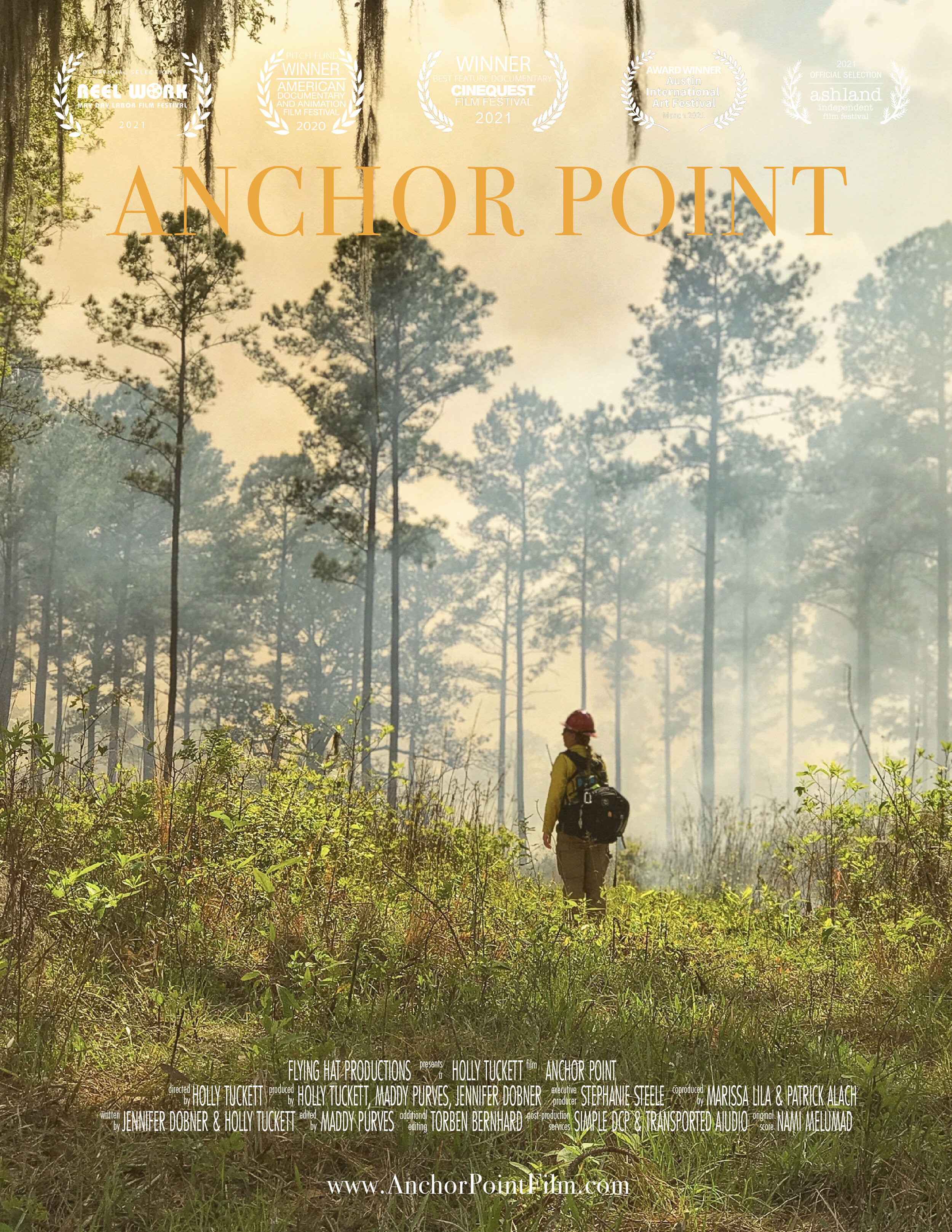
MDFF 2021 - Anchor Point

July 09, 2021 by Carmela Baranowska


Told in cinema verite, ANCHOR POINT chronicles the 2019 fire season through the eyes of two women, generations apart, as they push to change the culture of wildland fire.

Interview with Writer/Director/Producer Holly Tuckett

Congratulations! Why did you make your film?

Who wouldn't want to make a film about wildland fire and women who fight those fires? I definitely thought it would be an adventure, and when I met the women at the Women-in-Prescribed Fire Training Exchange, after researching for a number of months about the discrimination and harassment that these women have faced historically, I knew all too well the stories that they shared with me. Working as a woman in the film industry, many of their stories of the subtle ways that they were sidelined and overlooked, felt all too familiar. I wanted to make a film that wasn't preachy about it, but made the point through a character-driven narrative that made people care about the characters and then feel what they were feeling.

Imagine I’m a member of the audience. Why should I watch this film?

Audience members should watch this film because they are members of a society that needs to be inclusive and supportive of all of its members. Men should watch it because they have daughters, sisters and mothers who may face these same challenges in any field of work, and to become more aware of the subtle ways they may be contributing to the harmful environments and to become better allies. Women should watch it to know that they are not alone or to realize how in subtle ways they may be contributing to the harmful patriarchal systems that can be harmful and discouraging for women.

How do personal and universal themes work in your film?

As I mentioned before, being a woman in the film industry or any male-dominated industry has its difficulties and rewards. I really believe that many women will sit in the audience watching the film and nodding their heads, saying to themselves,"yes that has happened to me or my friends." I think that both Kelly and Lacey's stories are relatable to most women. The themes of having grit and perseverance to overcome obstacles, as well as finding those anchor points in your life to get you through hard times or just trying to find an anchor point to safely engage with your peers to make lasting and critical changes that not only benefit women, but men as well. These themes I believe are universal for anyone.

Anchor Point

Anchor Point

How have the script and film evolved over the course of their development?

The film most definitely evolved a bit over the course of making the film. The story started with one woman's story, but as she changed her focus, we had to pivot and find new characters and a way to tell the story in a more character driven way. The moment that I met Lacey and Kelly in person, (I had seen Kelly's testimony to congress as part of my research and Lacey was featured in an REI video that I came across) I knew that these two were kindred spirits approaching their careers in very different ways due to their generational differences. Once they were onboard I knew that the two approaches would make an interesting contrast and give people something to really ponder.

What type of feedback have you received so far?

The feedback that we have received so far has been great! Women are saying that they feel seen and men are saying that they "get it now," where perhaps before they just really couldn't understand how small comments or not standing up for their female colleagues takes a toll and has long lasting effects on the workplace in general. We even had the USDA Forest Service reach out to us and ask us to screen it for over one hundred wildland firefighters and their supervisors. The way the film tells the story makes people care about these women deeply and then seeing how they are affected, changes hearts and minds. It has been truly everything that I could have asked for as a filmmaker. My greatest wish for my work is for it to have an impact.

Has the feedback surprised or challenged your point of view?

The feedback has been surprising in that so many fire organizations are asking to see the film. Pun intended, it is spreading like wildfire through the wildland fire community. I had definitely hoped that it would be received well, but the response has exceeded that hope. I really want the film to make a lasting change for all wildland firefighters.

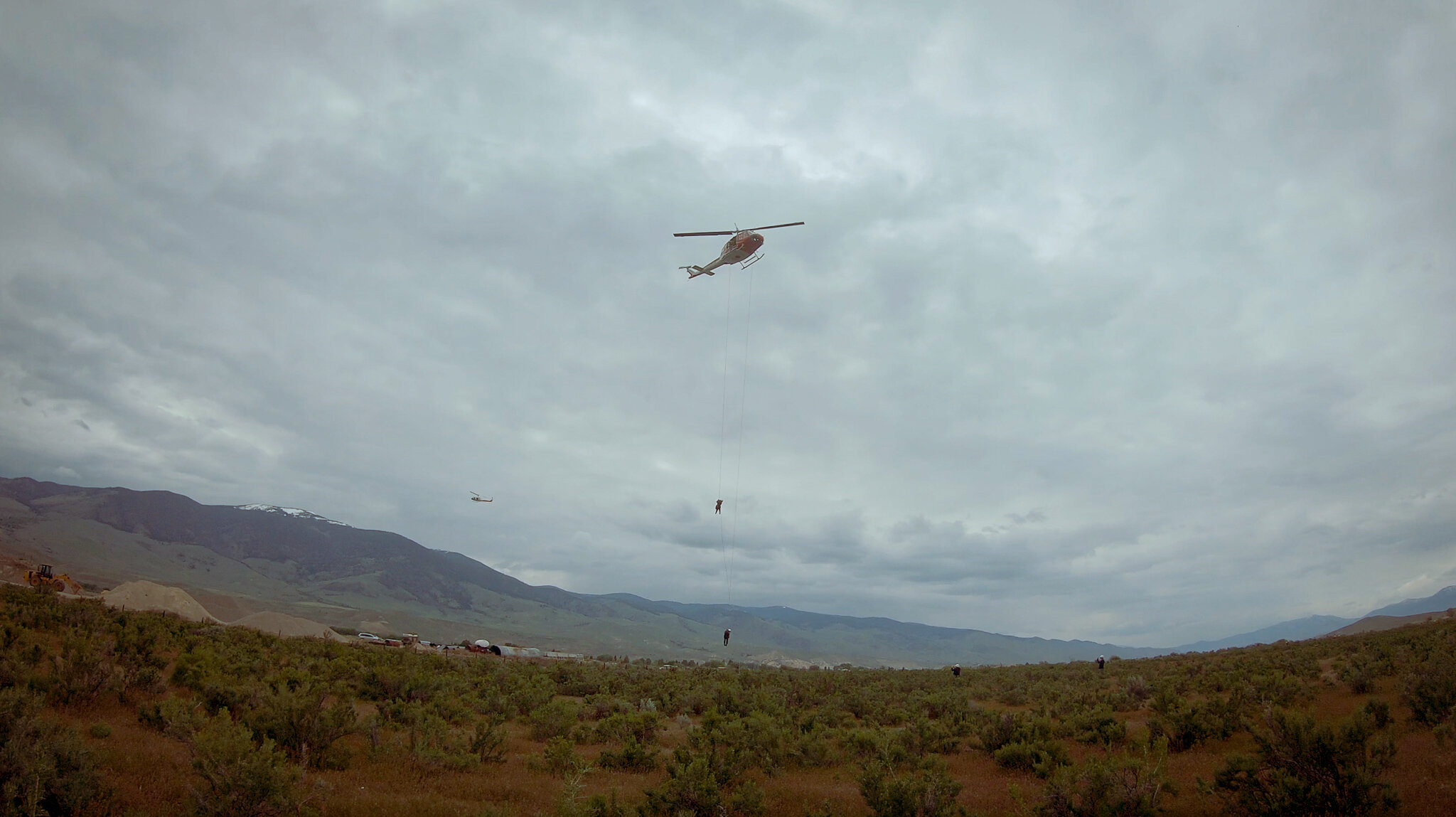
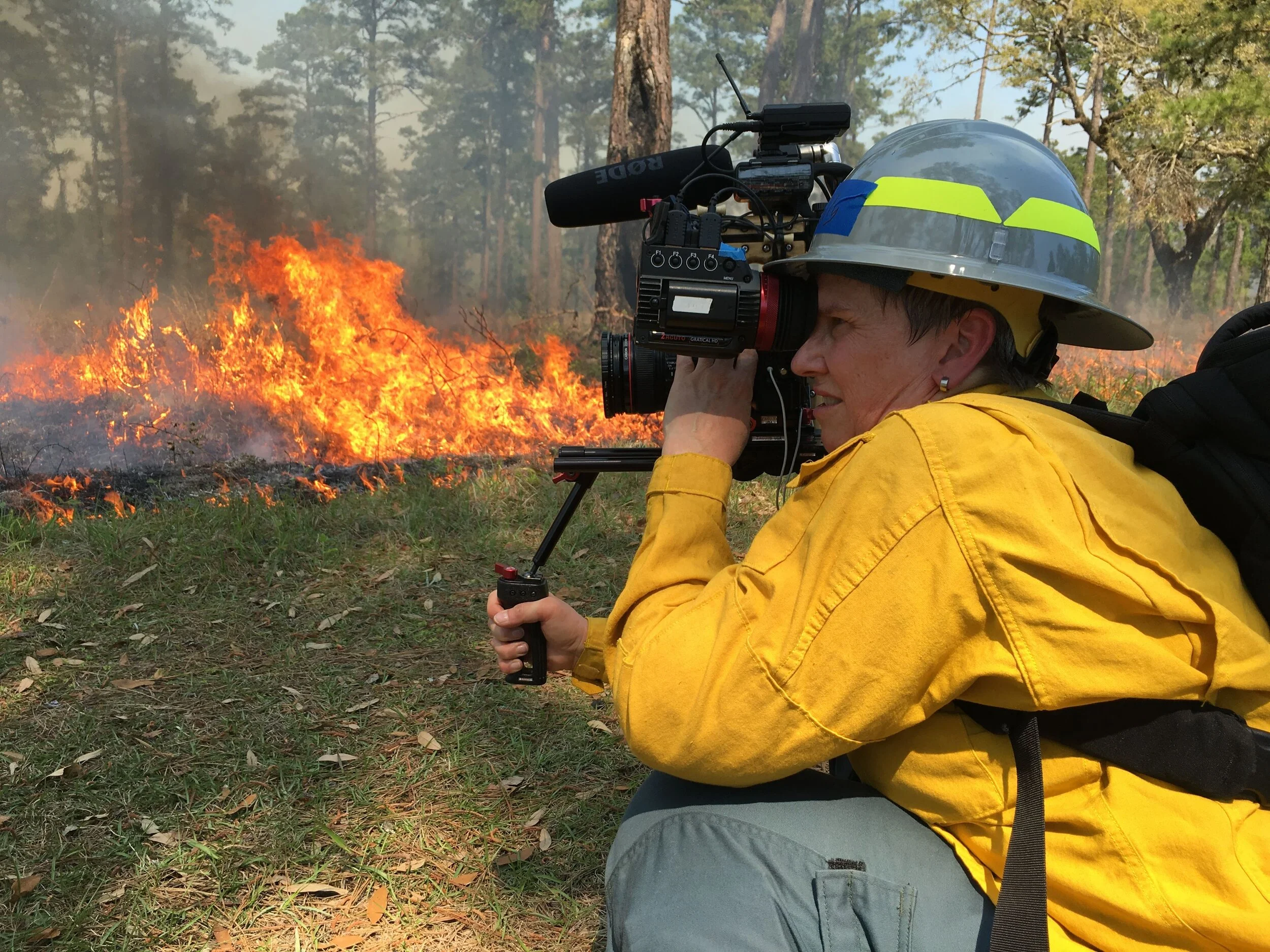
Behind The Scenes  - Anchor Point

Behind The Scenes - Anchor Point

What are you looking to achieve by having your film more visible on www.wearemovingstories.com?

I hope that having a presence on wearemovingstories.com will put the film out there for buyers/distributors. Although the film seems to have a niche in the fire world, this film is really a wonderful women empowerment tool, so it has a life out in the mainstream world as well!

Who do you need to come on board (producers, sales agents, buyers, distributors, film festival directors, journalists) to amplify this film’s message?

I would love for journalists to help get the word out about this film because we are a small independent team right now and could use some amplification. I would also love for buyers, distributors and film festival directors to really understand that this film is unique and also has broad audience appeal.

What type of impact and/or reception would you like this film to have?

The film is already having impact, and I would love to see the impact spread to other professions and environments where women should be a part of the solutions and ongoing dialogue. Diversity is good for the land and it is good for its people and inhabitants.

What’s a key question that will help spark a debate or begin a conversation about this film?

What are some of the subtle ways that women are discriminated against in the workforce and what are you (all people included) doing to uphold those archaic systems?

Anchor Point

Anchor Point

Would you like to add anything else?

This film is not just about women empowerment, you are going to get a wonderful education about why our world needs fire on the land and why suppression isn't always the answer. Suppression has gotten us to the horrible wildfire environment that we now are facing in our world, and suppressing women in the workforce is detrimental as well.

What other projects are the key creatives developing or working on now?

Our team is currently in development on a number of documentary and docu-series projects. One has similar themes to Anchor Point. We also are focusing in on social justice issues and topics that to which we live closely, because the best stories are told from a place of intimate knowing.

Interview: July 2021


We Are Moving Stories embraces new voices in drama, documentary, animation, TV, web series, music video, women's films, LGBTQIA+, POC, First Nations, scifi, supernatural, horror, world cinema. If you have just made a film - we'd love to hear from you. Or if you know a filmmaker - can you recommend us?  More info: Carmela


Anchor Point

Length: 1:30:30

Director/Producer/Cinematographer

Anchor Point is the second feature-length documentary film from veteran storyteller, filmmaker and cinematographer HOLLY TUCKETT. Her first, Church & State, debuted in 2018, winning a Special Jury Award at the American Documentary Film Festival in Palm Springs and Best Feature Documentary at the Nice International Film Festival in France. Her documentary short, Timi Earl Skelton Girl — which she produced, directed and edited — screened at the Park City Film Series in conjunction with the Sundance Film Festival in 2011. In addition to Anchor Point and Church & State, Holly’s producing credits also include the 2008 festival circuit favorite Una Vida Mejor. Through her company, Flying Hat Productions, Holly has contributed to nearly 100 narrative and documentary films and television productions, including work for National Geographic, Discovery, Vice, TLC, NBC Olympic broadcasts and more.

Writer

Jennifer Dobner & Holly Tuckett

JENNIFER DOBNER is a Salt Lake City-based journalist with more than two decades of reporting experience. Jennifer was a reporter for The Associated Press and for newspapers across the West, including The San Diego Union-Tribune, Idaho Falls Post-Register, Deseret News and The Salt Lake Tribune. As a freelancer she has worked for Reuters, The New York Times, Cannabis Wire and Outside Magazine Online. Jennifer has written extensively about the Mormon church, polygamy, gay rights, criminal justice, capital punishment and western land use issues. In 2018, she was a c0-writer and story consultant for the documentary film Church & State, which won a Special Jury Award at the American Documentary Film Festival in Palm Springs and Best Feature Documentary at the Nice International Film Festival in France. Also in 2018, Jennifer wrote and performed “Don’t Hit Your Head,” as part of the live True Stories non-fiction storytelling night featuring Salt Lake City journalists.

Producer

MADDY PURVES is an emerging filmmaker from the bicycle capital of the world, Davis, CA. Maddy received her BA of Media Studies in 2017, focusing on nonfiction and documentary film and since then has both edited and produced two award-winning feature films (“Same-Sex Attracted”, Anchor Point). With a love of doing good work, Maddy has extensive experience in a wide range of media production: she’s gripped, produced, ran camera and sound, edited, and even run live replay in front of 50,000+ sports fans. Maddy is a hard worker and a passionate creative. Maddy believes in the healing power of honest storytelling and is in search of projects that inspire love, compassion, and empathy.

Key cast:

Lacey England (Helitak Firefighter), Kelly Martin (Cheif of Fire and Aviation, Yosemite National Park)

Looking for:

distributors, film festival directors, buyers

Facebook:

https://www.facebook.com/AnchorPointDoc

Instagram:
https://www.instagram.com/anchorpointdoc/

Twitter:

https://twitter.com/AnchorPointDoc1

Hashtags used:

#AnchorPoint #AnchorPointFilm #WomenInFire #GirlOnFire #WildlandFire #firefighter #fire #femalefirefighter #futureisfemale #utahfilmcenter #femalefilmmakers #documentary #docs #film #filmmaking #helitack #metoo #women #hotshot #feminine #amdocs #gopro #nature #nationalparks #parksproject #flyinghat

More info:

https://www.anchorpointfilm.com/

Where can I watch it?

Melbourne Documentary Film Festival/Melbourne, Australia - July 1 - 31, 2021 Online, https://www.mdff.org.au/films/anchor-point; Denali Film Festival/Denali, Alaska, USA - July 15-18, 2021 Online, https://www.denalifilmfestival.com/tickets.html


HBOMax


July 09, 2021 /Carmela Baranowska
Comment

Focus on AFI Conservatory - A Rodeo Film

July 09, 2021 by Carmela Baranowska

A black bull rider must choose between his family's legacy and the woman he loves.

Interview with Writer/Director Darius Dawson

Watch on Hulu, HBO or Prime Video


Congratulations! Why did you make your film?

A Rodeo Film was my thesis at AFI, but I've been wanting to tell a story set in this world for some time now. A lot of people don't know that the original cowboys were actually black. The term cowboy was a derogatory term at one point. I hope that my film inspires people to learn more about black cowboys and black rodeo athletes.

Imagine I’m a member of the audience. Why should I watch this film?

I think that the world of the film is interesting...of course. Not a lot of people know about black rodeo athletes so I think that this culture sits at an interesting intersection between Western culture and African American culture. The film in a nutshell is about love and family. I feel that so much of what we do day to day revolves around love. I also feel that family is that thing in our life that's the toughest to figure out. I think that audiences should check out A Rodeo Film is they want to see flawed characters try to figure out love and family and how it all pieces together.

A Rodeo Film

A Rodeo Film

How do personal and universal themes work in your film?

The biggest thing at work here is questioning that bond of family. I think that, as I've gotten older, I've found myself struggling with who I really am, my true identity versus the one that was prescribed to me by people around me, namely family. I'm not saying this in a negative way. I'm a lower middle class black kid from the South so the pressure was always on to make something of myself because the alternative was not pretty. I think that my mother pushed my brother in I toward careers and activities and things in general that she thought would see us living a particular type of life. In this way that family bond was one that was giving me a certain identity that maybe wasn't necessarily who I was. My brother and I were both told that we would be engineers. We're both filmmakers now. I think that sometimes the bonds of family can become bondage. And I'm not saying that to suggest malicious intent in anyway it's just that sometimes even our family doesn't see us for who we really are.

How have the script and film evolved over the course of their development?

The script had times when it leaned heavy into the sports aspect of the rodeo, then other times where it leaned super heavy into the love triangle aspect. I think we struck some type of balance between the two.

What type of feedback have you received so far?

The film has been generally well received. I guess well enough for HBO to license it. I don't get too deep into IMdb reviews and all of that. The film isn't perfect. I know that. The film does, however, represent a lot of growth for me; as an artist, as a person. Thematically I'm very interested in family. It took me doing this film to realize that.

A Rodeo Film - Behind the Scenes

A Rodeo Film - Behind the Scenes

Has the feedback surprised or challenged your point of view?

I think that themes in my work that I'm interested in exploring more have come out in making this film. I kind of have a quarterbacks memory when it comes to films. I do it, I learn from it and move on. I learned a lot about managing tone, about themes and a host of other things making this film so that's been my biggest take away from the Rodeo short.

What are you looking to achieve by having your film more visible on www.wearemovingstories.com?

I just hope that more people go out of their way to learn about black cowboy culture and black rodeo athletes. It's a world that I've grown to know and I've fallen in love with and I suppose I just want to share it with whoever will have it.

What type of impact and/or reception would you like this film to have?

I hope that it raises awareness of this niche culture. If people dig it that's cool; if not that's fine too. But I think that if the film makes you want to take the extra step to google black cowboys then that's pretty cool.

What other projects are the key creatives developing or working on now?

Right now Ryan Binse and I are putting together the feature version of A Rodeo Film while working on a few other projects separately.

tileburnedin.jpg

A Rodeo Film


Interview: July 2021


We Are Moving Stories embraces new voices in drama, documentary, animation, TV, web series, music video, women's films, LGBTQIA+, POC, First Nations, scifi, supernatural, horror, world cinema. If you have just made a film - we'd love to hear from you. Or if you know a filmmaker - can you recommend us?  More info: Carmela


A Rodeo Film

Length: 19 minutes

Writer/Director

DARIUS DAWSON is a writer/director based in Los Angeles. He attended AFI Conservatory for directing and since graduating has directed several commercials and shows including for Peter and Bob Farrelly's Quibi show, The Now.

Producer

RYAN BINSE is a navy veteran and graduate of AFI's producing program. Since graduating Ryan has produced and line-produced several feature films and is currently in pre-pro for the feature version of A Rodeo Film.

Key cast:

Jermelle Simon, Charlee Earle, Phrederic Semaj

Looking for:

Facebook:

https://www.facebook.com/therodeofilm/

Instagram:

https://www.instagram.com/arodeofilm/

Hashtags used:

#arodeofilm #blackrodeo

More info:

www.dariusdawson.com

Made in association with:

AFI Conservatory

Where can I watch it now?
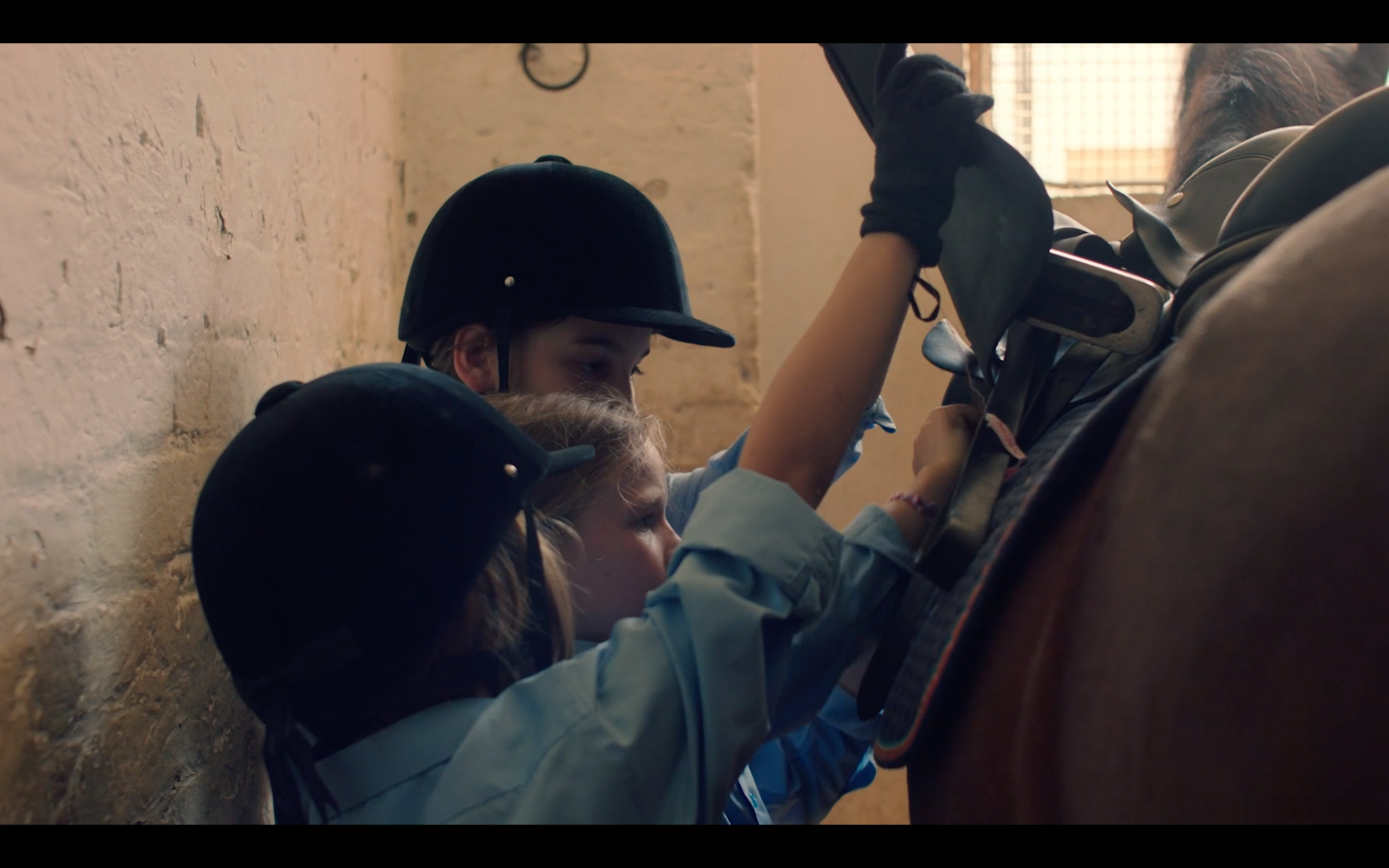
HBOMax

July 09, 2021 /Carmela Baranowska
Comment

Narcissus

August 12, 2020 by Carmela Baranowska

Under the familial pressure and countless rejections in her career, an Asian American actress blames everything on her appearance and blindly takes action to better herself.

Read More
August 12, 2020 /Carmela Baranowska
Comment

22. Anna Matthews

August 11, 2020 by Carmela Baranowska

An actress struggles to control her emotions during an audition for a TV commercial.

Read More
August 11, 2020 /Carmela Baranowska
Comment

Death Cafe

August 08, 2020 by Carmela Baranowska

A short documentary exploring the bizarre, yet supportive role of a Death Cafe, where strangers meet to discuss all forms of life and death, to form some closure about their recently-departed loved-ones.

Read More
August 08, 2020 /Carmela Baranowska
Comment

Nevada Women's Film Festival 2020 – Pool Party

August 06, 2020 by Carmela Baranowska

Nika, an introverted high schooler, lives every day feeling like an outcast. Marked with a significant scar on her stomach, she prefers to remain unnoticed, until a pool party invitation pushes her to confront all her insecurities.

Read More
August 06, 2020 /Carmela Baranowska
1 Comment

Student Emmy / American Pavillon 2020 – Welcome Back

August 05, 2020 by Carmela Baranowska

After being deported back to dangerous and communist Venezuela, Rosa and her daughter must find a way to escape to a nearby town in Colombia.

Read More
August 05, 2020 /Carmela Baranowska
Comment

Austin Film Festival 2019 – The Devil in the Doorway

August 03, 2020 by Carmela Baranowska

When a registered sex offender seeks redemption by helping a young runaway reunite with her family, his altruism and will are tested after the runaway betrays him to save herself.

Read More
August 03, 2020 /Carmela Baranowska
Comment

Pasifika Film Festival 2020 – Chicken

July 31, 2020 by Carmela Baranowska

All Barbara wants to do is watch the Simpsons, but her recently migrated mum has just been overcharged at the local shops, and it’s up to Barbara to sort it out. As usual.

Read More
July 31, 2020 /Carmela Baranowska
Comment
  • Newer
  • Older
 
No results found
 

© We Are Moving Stories 2016.